
When a Storm Opens Up Your Roof in Colorado
Front Range weather doesn't ease into damage, it arrives all at once. A hailstorm rolling off the foothills, a wind gust that snaps a cottonwood limb, a sudden downpour finding a weak spot that's been quietly failing for years, any of these can leave you standing in your living room looking up at open sky or a dark, spreading stain. The moment you notice it, the clock starts. Water doesn't wait for business hours and it doesn't care that the storm already passed.
What you do in the first 24 hours matters almost as much as the repair itself. A fast, calm response protects your belongings, limits structural damage, and gives your insurance company a clean record of what happened and when. This guide walks through exactly what to do, what to leave alone, and when to pick up the phone for emergency roof repair.
Why the First Few Hours Make the Difference
Water is lazy. It follows the easiest path down through insulation, along rafters, and into drywall, often showing up several feet from where it actually entered. The longer an opening sits uncovered, the more framing, insulation, and ceiling material gets saturated, and saturated material has to be replaced, not dried out. That turns a roof repair into a repair plus an interior rebuild.
Inside the House: What to Move and Catch
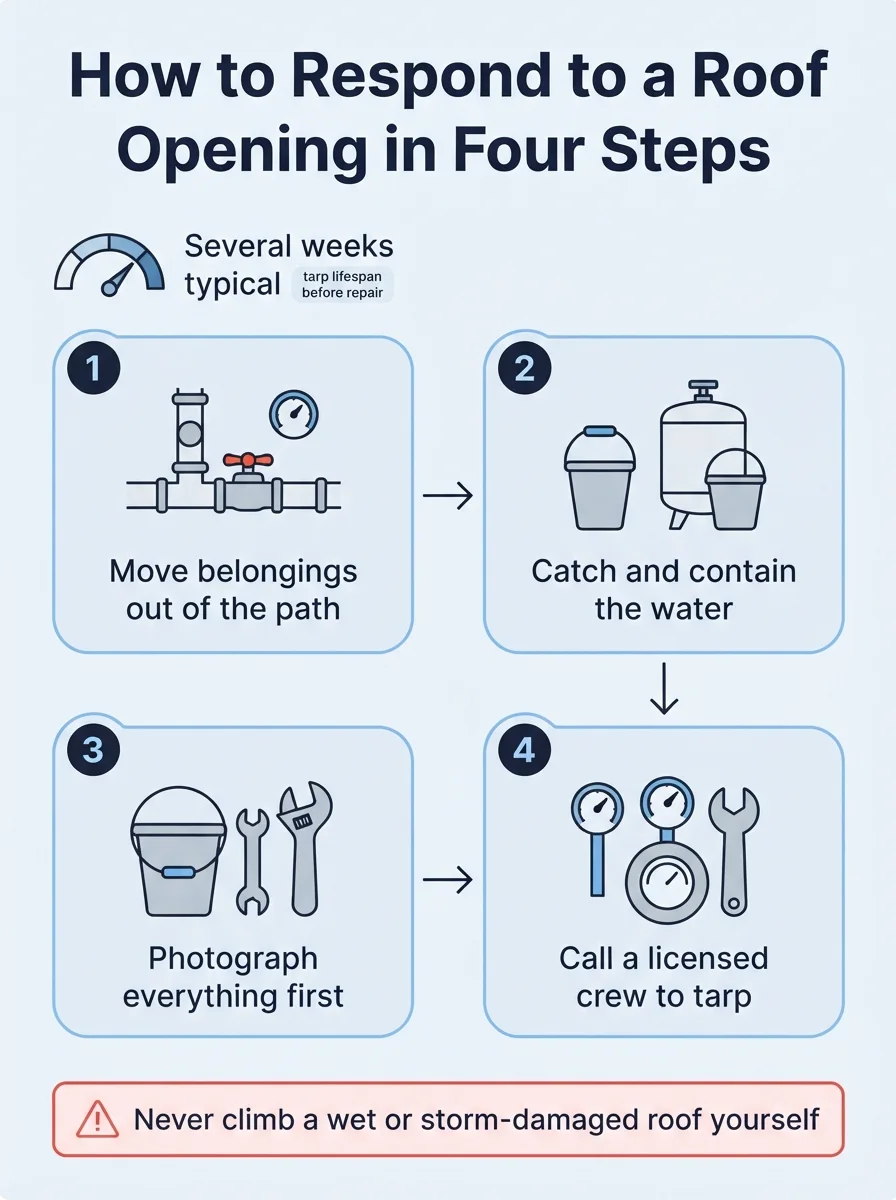
Start inside, where you have the most control. Pull furniture, electronics, and anything irreplaceable out from under the drip or stain. Lay down towels or a tarp of your own on the floor, and set a bucket or bin directly under the leak. If the ceiling is bulging with trapped water, a small controlled puncture with a screwdriver can relieve pressure in a bucket rather than letting it collapse somewhere less predictable.
Shut off power to any outlets or fixtures near the water if you can safely reach the breaker panel. Water and electrical wiring are a dangerous combination, and it's one problem you can eliminate in under a minute without going anywhere near the roof itself.
Outside: What Not to Touch
Resist the urge to get up there yourself, especially while it's still raining or the shingles are wet. A damaged roof deck can be softer than it looks, and a slick surface plus a hole you can't fully see is a bad combination even for someone experienced. This is where a licensed crew earns its keep.
If a limb or debris is resting on the roof, leave it in place unless it poses an immediate hazard to a door or walkway below. Moving it yourself can open the damage further or shift weight onto a weakened section. Document it with photos from the ground instead.
| Task | Who Handles It | Why |
|---|---|---|
| Catching and moving water inside | Homeowner | Fast, low-risk, limits interior damage |
| Photographing the damage | Homeowner | Safe from the ground, builds the insurance record |
| Climbing onto the roof | Licensed crew | Wet, damaged decking is unstable and slick |
| Installing and anchoring a tarp | Licensed crew | Requires proper securing so wind doesn't tear it loose |
What a Tarp Actually Does (and Doesn't Do)
A tarp is a temporary shield, not a fix. Done right, it's stretched tight over the opening and anchored with furring strips or fasteners driven into solid wood framing, not just into the shingles themselves, so wind can't get underneath and peel it back. That's the part that trips up a well-meaning homeowner, a loose edge on a windy day turns a tarp into a sail and the opening is exposed again, often worse than before.
What it will do is buy time, keeping active weather out while a permanent fix gets scheduled and, if needed, an insurance claim gets processed. What it won't do is address the underlying cause. A tarp over a hail-cracked section or storm-torn flashing is a placeholder, and treating it as the finished job is how small damage turns into a much bigger problem by the next storm.
Step-by-Step: Tarping a Damaged Roof Safely
This is the sequence a crew follows once they're on site, and it's worth knowing even if you're not the one doing the climbing.
- Assess the opening: A crew checks the size of the damage and the condition of the surrounding deck before anyone sets foot near the hole.
- Clear debris: Loose shingles, branches, and granules are cleared so the tarp lies flat against the roof surface.
- Measure and cut: The tarp is sized to extend well past the damage on every side, not just cover the hole itself.
- Anchor into framing: Furring strips are fastened through the tarp into solid rafters or decking, not just the shingle layer.
- Seal the edges: Edges are folded and secured so wind-driven rain can't work its way underneath overnight.
- Photograph the finished tarp: A final set of photos documents the temporary fix for the homeowner's and insurer's records.
What You'll Find Once the Tarp Is Up
Signs the Damage Reaches Further Than the Opening
Once the immediate leak is covered, it's common to notice the damage wasn't as contained as it first looked. Soft spots a few feet from the hole, cracked shingles nearby, or a sagging section of gutter can all point to wind or impact stress that spread beyond the obvious entry point.
This is exactly why a full inspection matters after the tarp goes up, not just a patch job on the one visible hole. A crew walking the roof can map out everything the storm touched, which is the difference between fixing the symptom and fixing the cause. For more on reading wind and hail aftermath, see our guide on storm and hail damage signs.
What the Documentation Should Capture
Good documentation includes wide shots of the whole roof section, close-ups of the actual opening or cracked material, and interior photos of any water staining or dripping. Timestamps matter too, so photos taken the same day as the damage carry more weight with an adjuster than ones taken a week later after things have dried out.
If a crew comes out to tarp the roof, ask them to document what they find before and after they cover it. Photos handed to you the same day make it far easier to move an insurance claim forward without a gap in the paper trail.
DIY vs. Calling a Licensed Crew
There's a real line between what a homeowner can safely handle and what needs a professional, and it mostly comes down to elevation. Everything inside the house, catching water, moving belongings, shutting off nearby power, documenting with photos, is fair game and genuinely helps. None of it requires going near the roof surface.
Everything on the roof itself is a different story. Wet shingles, an unstable deck, and an opening you can't fully see from below add up to real fall risk, and a tarp that isn't anchored correctly can do more harm than good. A licensed crew carries the right fasteners, the right tarp grade, and the experience to know where it's safe to step.
If the damage came from a storm, it's also worth getting a full roof inspection once the tarp is secure, so you know whether you're looking at a patch repair or something larger before the claim moves forward.
Getting Through the First Night
The first few hours after a roof opens up are stressful, but they don't have to be chaotic. Move what you can, catch the water, photograph what you see, and keep yourself off a wet roof no matter how tempting it is to go take a look. Homeowners from Denver to the foothill towns deal with the same fast-moving weather, and the response is the same everywhere: protect the inside, document the damage, and get a crew on the roof itself.
Once the immediate danger has passed, the real work is figuring out what the storm actually did and getting it fixed right the first time. Precise Roofing handles that call day or night, from the first tarp to the final repair.
Frequently asked questions
What should I do first if my roof is leaking during a storm?
Move anything valuable out from under the leak and set a bucket or bin to catch the water before it spreads to the floor or walls. Stay off the roof itself until the storm passes and a crew can assess it safely.
Is it safe to tarp my own roof after storm damage?
It's not recommended. A storm-damaged roof deck can be unstable, wet surfaces are slick even on a low slope, and a tarp that isn't anchored correctly can rip loose and let more water in overnight.
How long can a tarp stay on a roof before it needs a real repair?
A properly secured tarp is meant to hold for a matter of weeks, not months, and should be treated as a bridge to a permanent fix, not a substitute for one. Sun and wind break tarps down faster than most people expect.
Will my insurance cover emergency tarping?
Many homeowner policies cover reasonable steps taken to prevent further damage after a covered event, which is often why insurers want the opening addressed quickly and documented with photos. Check your specific policy or ask your adjuster directly.
Should I take photos before or after the roof is tarped?
Before, if it's safe to do so from the ground or a window. Photos of the original opening, the debris, and the interior damage give your insurance company and your roofer a clear record of what happened before anyone covers or clears it.