
When a Colorado Roof Claim Comes Back Denied or Underpaid
Front Range and mountain-corridor homeowners file roof damage claims after nearly every significant hailstorm or windstorm, and a fair number of those claims come back with a denial letter or a payout that doesn't cover the actual scope of work. That outcome feels final, but it rarely is. Insurance policies include review and dispute mechanisms precisely because initial adjuster estimates miss things, whether that's a shaded slope, hidden flashing damage, or a difference of opinion on whether the roof's condition was storm-related or just age.
The key is knowing the difference between a denial you can challenge and one that reflects real policy limits, and knowing which steps actually move the needle versus which ones just burn time. This guide walks through why claims get denied or underpaid, what tools exist to push back, and where a roofing contractor's documentation fits into that process without crossing into legal or insurance advice.
Why Insurance Companies Deny or Lowball Roof Claims
Adjusters are working from a single site visit, often on a day when they're inspecting several properties back to back after a regional storm. Mistakes and conservative calls happen on both the roof-condition side and the paperwork side of the claim.
Reasons Tied to the Roof Itself
The most common reason for denial is a classification of wear and tear or cosmetic damage rather than storm damage. An adjuster may note granule loss or shingle curling and attribute it to age even when hail bruising is also present. Another frequent issue is a partial inspection, where only the most visible slope gets a close look and others are assumed to match.
Pre-existing damage is another flagging point. If a roof already had deferred maintenance issues, insurers sometimes attribute all current damage to that prior condition rather than the recent storm, even when the storm clearly made things worse. This is where dated, slope-by-slope photo documentation from a roof inspection matters most.
Reasons Tied to the Claim Process
Underpayment often has nothing to do with whether damage exists and everything to do with how the estimate was scoped. An adjuster's software-generated estimate might price out a repair when a full slope or full roof replacement is what code and manufacturer specifications actually require for matching materials.
Missing line items are common too: flashing, underlayment, ventilation components, or gutters damaged in the same storm sometimes get left off the first estimate entirely. A documented scope comparison, not just a verbal disagreement, is what gets these added back in through a supplement.
| Situation | What it usually looks like | Your first move |
|---|---|---|
| Full denial | Letter stating damage is wear and tear, cosmetic, or pre-existing | Request a written explanation and a re-inspection with documentation |
| Underpaid approval | Check or estimate that covers less scope than the actual damage | Submit a supplement with photos and a contractor's written findings |
| Disputed value, agreed damage | Insurer and homeowner agree damage exists but disagree on cost | Consider invoking the appraisal clause if your policy includes one |
What a Supplement and a Re-Inspection Actually Do
A re-inspection is a second look at the property, usually requested when new information or additional damage has come to light since the original adjuster visit. It doesn't restart the claim; it adds to the existing file. Bringing dated photos, slope measurements, and a written scope from a roofing professional to that re-inspection gives the adjuster something concrete to compare against their original notes rather than asking them to take your word for it.
A supplement is the formal paper trail version of that same idea. Instead of a site visit, you or your contractor submit a written request itemizing what was missed or underpriced, backed by photos and, where useful, measurements or code requirements that explain why a full slope or full replacement is necessary rather than a patch. Insurers are required to respond to a properly submitted supplement, and many legitimate ones get at least partially approved once the documentation is in front of the right adjuster.
Step-by-Step: What to Do After a Denial or Lowball Payout
Work through these steps roughly in order. Not every claim needs every step, but skipping the documentation steps early almost always costs time later.
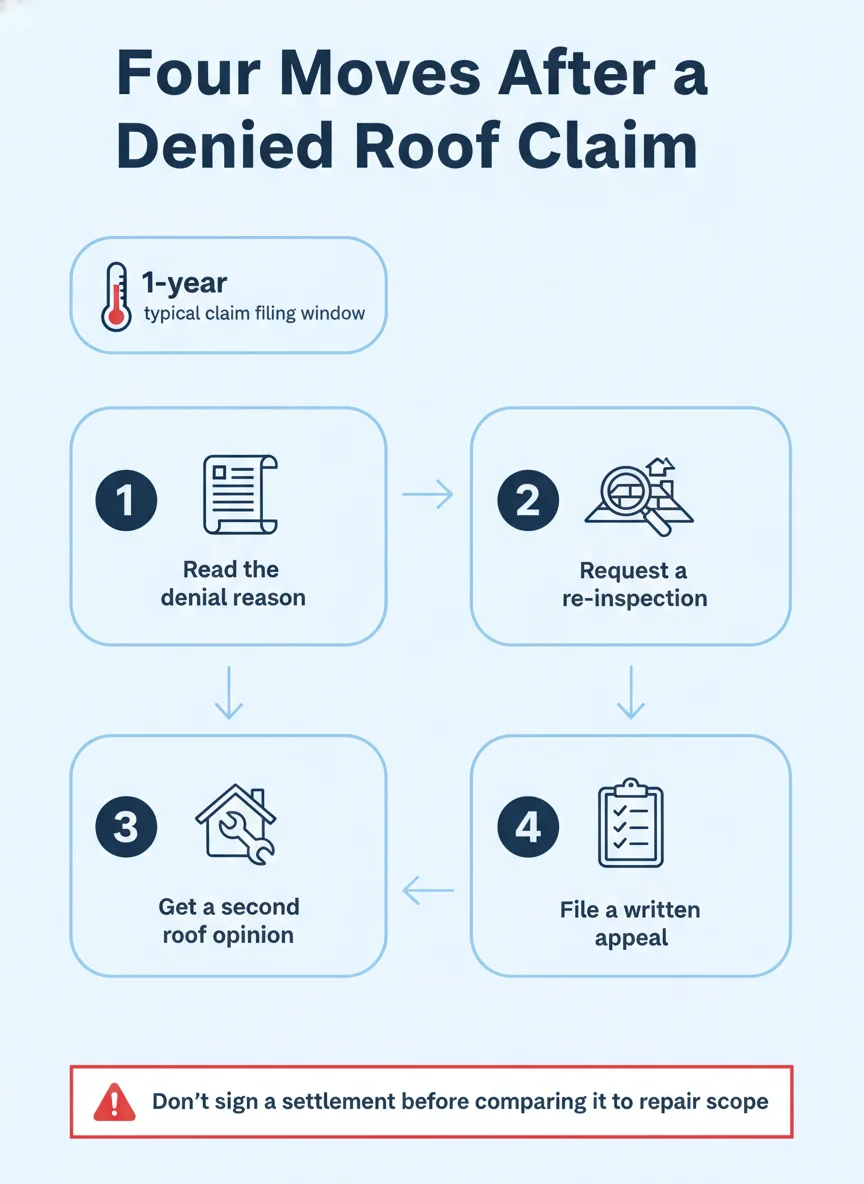
- Read the denial letter closely: Identify the exact stated reason for denial or the exact line items that were reduced or cut, since your response needs to answer that specific reason.
- Get a second roof opinion: Have a licensed roofer document the full roof condition independently, including slopes the original adjuster may not have walked.
- Compare scopes side by side: Line up the insurer's estimate against the contractor's findings to see exactly what's missing or underpriced.
- Request a re-inspection: Submit the request in writing and bring the photo documentation and measurements to the scheduled visit.
- File a supplement if scope was missed: Submit itemized, photo-backed requests for anything left off the original estimate, from a damaged slope to missing flashing.
- Consider the appraisal clause: If damage is agreed upon but the dollar value is still far apart, check whether your policy includes an appraisal process for resolving that gap.
- Escalate if needed: A complaint to your state insurance department or a conversation with a public adjuster are options if the insurer isn't engaging with documented evidence.
What You'll Find When You Dig Into the Adjuster's Report
When the Report Misses Damage
It's common to find that an adjuster's report only addresses the slope or two that were easiest to view from the ground or from a single vantage point. If your roof has multiple pitches, dormers, or sections facing different directions, damage severity can vary a lot from one slope to the next, and a quick visual pass can genuinely miss it.
A full walk of every slope, ideally with photo timestamps, is the clearest way to show what the original report didn't capture. This is the kind of documentation that turns a disagreement into evidence the insurer has to respond to.
When the Report Cites Wear and Tear
Wear and tear denials are harder to overturn outright, especially on an older roof, but they're not always the end of the story. If a storm date can be tied to specific, fresh damage (bruised mat, cracked seals, fresh granule displacement in a pattern consistent with hail) that's distinct from gradual aging, that distinction is worth documenting and presenting.
In cases where the roof genuinely was near the end of its service life before the storm, it's worth having an honest conversation about what portion of the damage is attributable to the event versus what was already coming. A contractor's written assessment, separate from the claim fight itself, helps you plan either way.
What a Roofer Can Do, and What's Ultimately Your Call
A roofing contractor can document roof condition, identify storm-related damage, measure and photograph every slope, and put a written scope in front of the insurer that matches building code and manufacturer requirements for things like matching shingles across a roof plane. That documentation is often the single biggest factor in getting a denial reconsidered or a supplement approved.
What a contractor generally can't and shouldn't do is negotiate the legal terms of your policy, interpret coverage language on your behalf, or guarantee a specific outcome with the insurer. Those are decisions that sit with you, your policy, and in more involved disputes, an attorney or public adjuster who works directly with insurance law.
Escalation paths like the appraisal clause, a public adjuster, or a complaint filed with your state insurance department exist for cases where documentation alone hasn't resolved the disagreement. None of those paths require you to have already hired a contractor, but having a clear, independent written scope in hand makes each of them more effective.
Getting to a Fair Outcome on Your Claim
A denial letter or a check that's clearly short of the actual repair cost is frustrating, but it's a starting point for a conversation, not a locked decision. Understanding why the claim was denied or underpaid, documenting the roof thoroughly, and knowing which escalation tool fits the specific disagreement are what turn a stuck claim into a resolved one. For a sense of how the broader claim process typically unfolds from storm to final payout, see the roof insurance claim timeline.
If you're in Denver or anywhere else along the Front Range dealing with a denied or underpaid claim, a documented storm damage inspection is usually the clearest next move before you respond to the insurer. Precise Roofing has worked alongside homeowners and insurance companies on claims like this for 20 years in the Denver Metro area.
Frequently asked questions
Why would my insurance company deny my roof claim?
Most denials come down to the insurer classifying the damage as wear and tear, cosmetic only, or pre-existing rather than storm-caused. A re-inspection with clear photo documentation and a dated storm event often changes that outcome.
What does it mean if my roof claim was underpaid?
An underpaid claim usually means the adjuster's estimate left out damaged slopes, used lower-cost materials than your roof actually has, or missed related work like flashing and decking. A supplement request can correct the scope once documented.
What is a supplement in a roof insurance claim?
A supplement is a formal request to add items or costs the original adjuster estimate missed, submitted with photos, measurements, or a contractor's written findings. Insurers review supplements against the policy and either approve, partially approve, or deny the added amount.
What is the appraisal clause and when would I use it?
The appraisal clause is a dispute process many homeowner policies include that lets you and the insurer each hire an independent appraiser to agree on the damage amount. It's typically used when you and the insurer agree damage exists but disagree sharply on the dollar value.
Should I hire a public adjuster for a denied roof claim?
A public adjuster works for you instead of the insurance company and can be worth considering on a complex or repeatedly denied claim. Review any fee agreement carefully before signing, since public adjusters typically work on a percentage of the settlement.