
Why the claim timeline matters more than the storm itself
A hailstorm or high wind event across the Denver Metro and the Front Range can leave hundreds of roofs damaged in a single afternoon, and every one of those homeowners files a claim within the same few weeks. That bottleneck is the real reason claims feel slow, not because insurance companies are dragging their feet on purpose. Knowing the order of events ahead of time keeps you from panicking when the adjuster takes longer than you expected to call back.
The timeline below covers the general shape of a roof claim in Colorado from the moment you notice damage to the day the final invoice gets paid. Every policy and every carrier has its own quirks, so treat this as the map, not the exact mileage. Your Storm & Hail Damage inspection is usually the first concrete step, and it's the one that sets everything else in motion.
What actually drives the pace of a claim
A claim moves at the speed of two things: how quickly the damage gets documented and how backed up the carrier's adjusters are. Both are partly outside your control, but you can control how fast and how thoroughly the first step happens.
Documentation quality
An adjuster is comparing your contractor's photos and notes against their own inspection. The more specific and dated that documentation is, the faster a fair number gets agreed on without back-and-forth. Photos from the ground, from the attic if there's interior evidence, and close-ups of hail hits on shingles, flashing, and gutters all help build a complete picture.
Vague documentation, a few blurry phone photos with no notes, tends to slow things down because the adjuster has to ask follow-up questions or schedule a second visit. A roofer who's walked hundreds of Colorado roofs after hailstorms knows what an adjuster needs to see and photographs it the first time.
Carrier workload after a regional storm
When a hailstorm hits a wide area, every carrier gets flooded with claims at once, and adjusters get assigned more homes than they can visit in a normal week. That's the single biggest variable in how long you'll wait for a scheduled inspection, and it has nothing to do with your specific claim or your contractor.
Filing early, right after the storm instead of waiting a few weeks, puts you earlier in that queue. It won't guarantee a fast turnaround, but it beats waiting until the backlog peaks.
| Stage | Typical timing | Who handles it |
|---|---|---|
| Damage documented and claim filed | Within days of the storm | Homeowner, with contractor inspection |
| Adjuster visit scheduled | 1 to 3 weeks after filing | Insurance carrier |
| Estimate approved, deductible applied | Days to a couple weeks after inspection | Insurance carrier and homeowner |
| Build scheduled and completed | Varies with contractor backlog and materials | Roofing contractor |
The pieces of a claim you'll actually deal with
A roof claim has a handful of moving parts: the inspection, the adjuster meeting, the estimate, the deductible, and the payout structure. Understanding each one before you're in the middle of it makes the whole process less confusing.
Your policy sets most of these terms, so the details, deductible amount, whether you carry ACV or RCV coverage, any depreciation schedule, live in your declarations page. If you're not sure what you have, a call to your agent before the storm even hits is time well spent. After damage occurs, your contractor's job is to document the roof accurately and meet the adjuster to make sure the approved scope matches what the roof actually needs, covered in more detail in Storm & Hail Damage.
Step-by-step: how a roof claim moves from storm to new roof
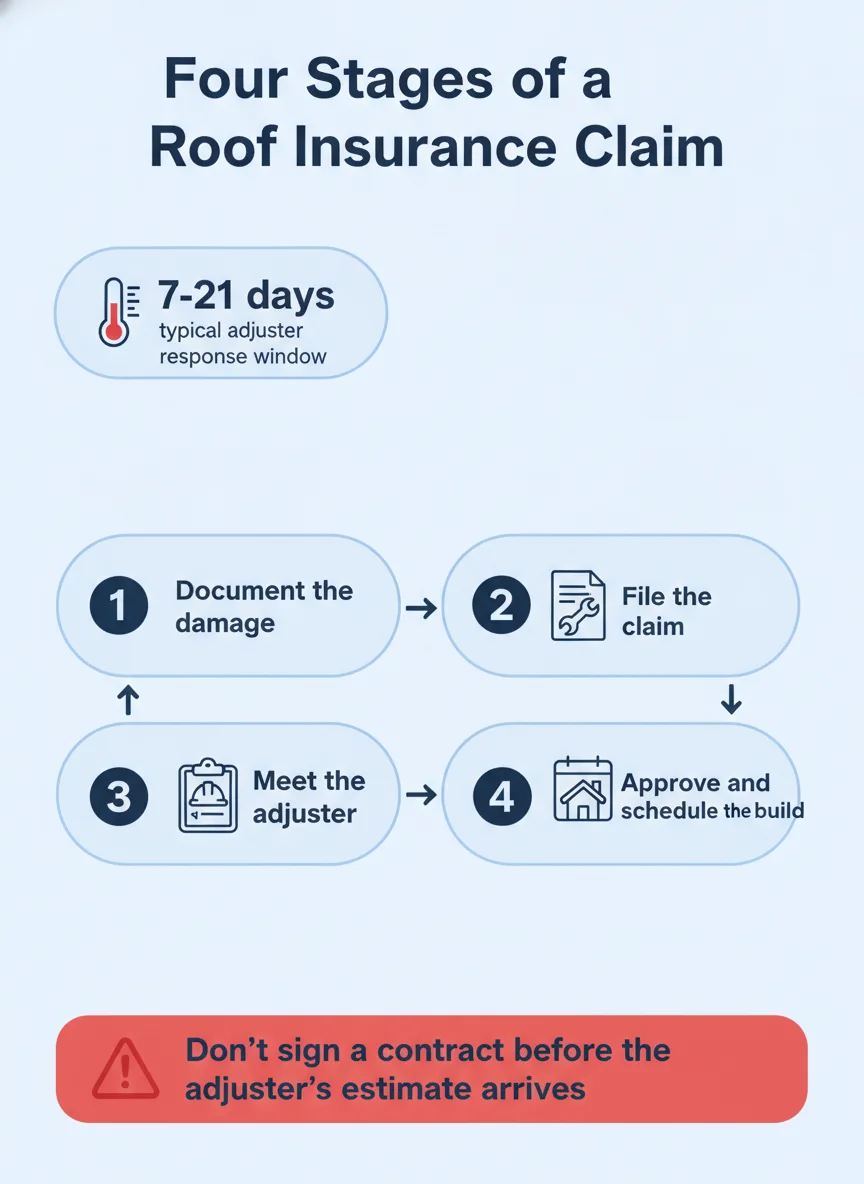
Here's the general order most Colorado roof claims follow. Some steps overlap, and a supplement can add a loop back into the middle of the sequence, but this is the backbone.
- Document the damage: Take photos of visible hail hits, missing shingles, or wind damage as soon as it's safe to do so, and get a professional roof inspection within a few days.
- File the claim: Call your insurance company to open the claim and get a claim number. Have your policy number and the storm date ready.
- Schedule the adjuster visit: The carrier assigns an adjuster to inspect the property, usually within one to three weeks depending on how many claims they're handling.
- Meet the adjuster on site: Your contractor walks the roof alongside the adjuster to point out damage and make sure nothing gets missed in the estimate.
- Review the estimate: The carrier issues a written estimate covering the approved scope of work and the payout structure, ACV or RCV, under your policy.
- Apply the deductible: Your out-of-pocket deductible is subtracted from the total payout according to your policy terms.
- Schedule and complete the build: Once the scope is approved, the contractor orders materials and schedules the replacement, then submits the final invoice to release any remaining recoverable depreciation.
What you'll find once the estimate comes back
The adjuster's estimate is the document that sets your budget and your scope, so reading it carefully matters more than almost anything else in the process.
When the estimate matches the damage
If the adjuster's line items line up with what your contractor found during the inspection, the claim moves forward cleanly. The payout structure kicks in, ACV releases first if that's your coverage type, the deductible gets applied, and the build gets scheduled once materials are confirmed.
This is the smoothest version of the process, and it's more likely when the original documentation was thorough and the adjuster had a clear picture of the damage before writing the estimate.
When the estimate falls short
Sometimes an adjuster misses damage, a section of flashing, a ridge cap, interior staining from a slow leak, especially on a roof with multiple slopes or hard-to-reach sections. When that happens, the estimate comes in lower than the actual cost to do the work correctly.
Your contractor can file a supplement, additional photos and notes sent back to the adjuster requesting a revised number. This adds time to the timeline but it's a normal part of the process, not a sign anything went wrong.
What you can handle yourself versus what needs a pro
You can absolutely make the first call to your insurance company, gather your policy details, and take exterior photos from the ground before anyone else gets involved. That part doesn't require a license, just attention and a phone camera.
Where you want a licensed contractor involved is the roof inspection itself and the adjuster meeting. Climbing onto a storm-damaged roof without the right footing and tools is a real fall risk, and an untrained eye can miss the difference between cosmetic hail marks and damage that will actually let water in over time. A Roof Inspections visit before you even file gives you documentation to bring to the call.
The supplement process, negotiating scope differences with an adjuster, is also best left to a contractor who does it regularly. It's a paperwork and communication skill as much as a roofing one, and a contractor who's been through it before knows what language and documentation gets a revised estimate approved faster.
Getting from storm to finished roof without the guesswork
A roof claim in Colorado isn't a single phone call, it's a sequence of steps that each take their own amount of time, and the biggest variable is usually how backed up the carrier is after a regional storm. Knowing the order ahead of time, documentation first, then filing, then the adjuster visit, then the estimate, then the build, takes a lot of the uncertainty out of it.
If a recent storm left you staring at shingles on the lawn or water stains on a ceiling, a Roof Repair or full inspection is the logical next move before the claim clock even starts. For more on what the damage itself usually means, Hail or Wind Damage After a Storm: What It Usually Means and When to Call walks through the warning signs. Precise Roofing has guided Denver Metro homeowners through this process for over 20 years, and the team can walk your specific policy's terms with you before the first call ever gets made.
Frequently asked questions
How long does a roof insurance claim take from start to finish in Colorado?
It varies by carrier and how busy they are after a widespread storm, but most claims move from the initial call to a scheduled build within a few weeks once the adjuster's estimate is in hand. Claims filed right after a major regional hailstorm can take longer simply because adjusters are stretched thin across more homes.
What is the difference between ACV and RCV on a roof claim?
ACV, or actual cash value, pays out the depreciated value of your roof, while RCV, or replacement cost value, pays the full cost to replace it with new materials. Most policies pay ACV first and release the recoverable depreciation, the difference between the two, after the work is completed and the final invoice is submitted.
Do I have to pay my deductible on a roof claim?
Yes, your deductible is the portion of the claim you're responsible for under your policy, and it applies before insurance coverage picks up the rest. A contractor who offers to waive or absorb your deductible is doing something most insurance policies don't allow, so it's worth asking questions if you hear that offer.
Can I choose my own roofing contractor for an insurance claim?
Yes, the choice of contractor is yours, not the insurance company's. Some carriers maintain a preferred vendor list, but you aren't required to use it, and picking a contractor you trust to meet the adjuster and build to the approved scope matters more than picking from a list.
What happens if the insurance adjuster's estimate is lower than my contractor's?
This is common and usually means some damage wasn't captured during the first inspection. Your contractor can submit a supplement, additional documentation and line items, back to the adjuster to request a revised estimate that matches the actual scope of work needed.