
Why metal roofing keeps coming up in Colorado
Front Range and mountain-corridor homeowners deal with a weather mix that's hard on roofing: intense UV at altitude, wide temperature swings between day and night, hail that can show up any month from spring through fall, and wind that doesn't let up in open areas east of Denver. Metal roofing has built a reputation in this climate because it resists UV breakdown, sheds snow rather than holding it, and handles wind uplift better than lighter materials when it's installed correctly.
That reputation is why more homeowners across Englewood, Denver, and the surrounding metro are asking about metal as an alternative to asphalt shingles, especially when it's time for a full roof replacement. It isn't the right fit for every home or every budget, but understanding how the panel types differ and how metal actually performs up here helps homeowners ask better questions when they're comparing options.
How a metal roof is actually built
A residential metal roof isn't just sheet metal nailed to the rafters. It starts with the same decking as a shingle roof, then adds an underlayment layer rated for metal, and finally the panels themselves, fastened either through hidden clips or exposed screws depending on the system. The panel profile, the fastening method, and the gauge of metal all affect how the finished roof performs over 40 to 70 years, which is the range most manufacturers and roofing associations cite for a well-installed metal roof.
Standing seam panels
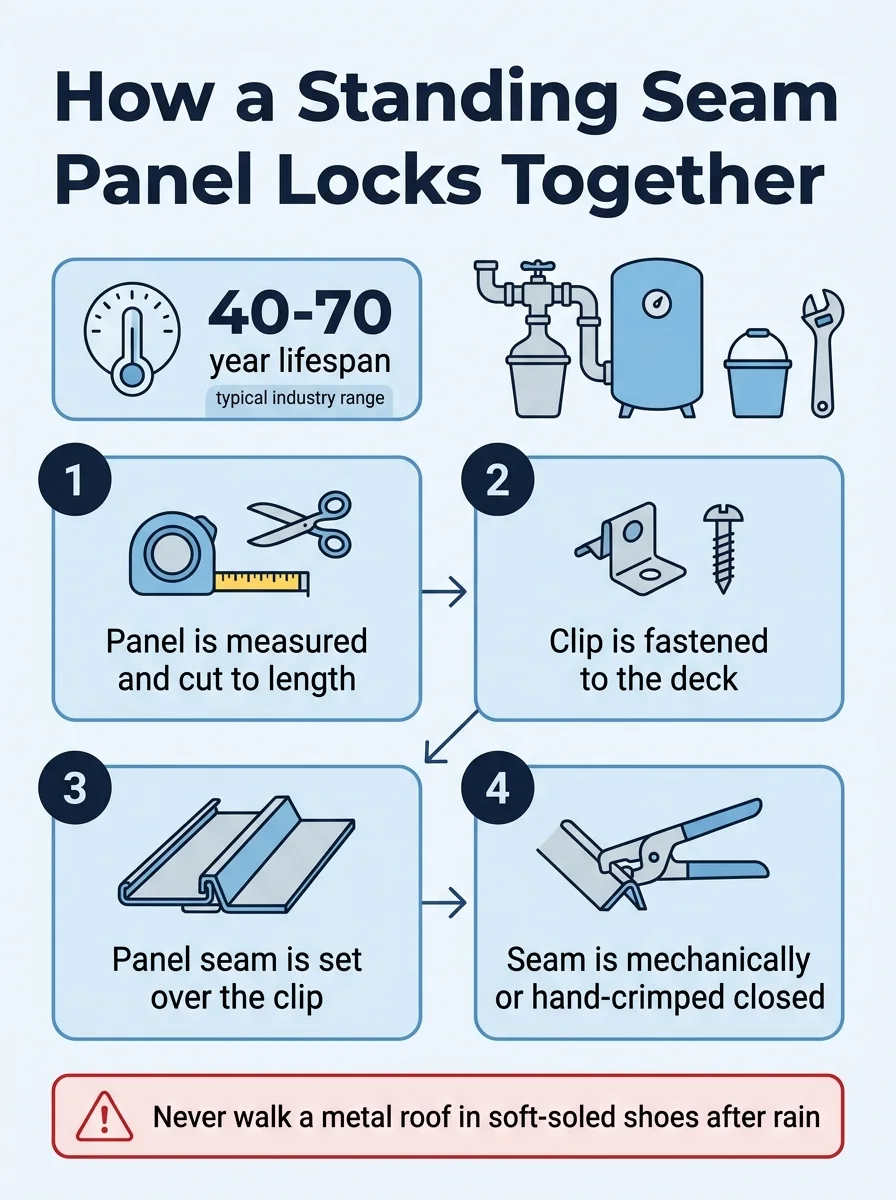
Standing seam panels run vertically up the roof slope and lock together along raised seams, with the fasteners hidden underneath where weather can't reach them. Because nothing punctures the panel face, there's no exposed screw to loosen, rust, or leak over time, which is a big part of why this system carries the longest warranty periods in the metal category.
The tradeoff is cost and installation skill. Standing seam requires more precise fabrication and a crew that's done it before, since a poorly formed seam is the most common source of a leak on this type of roof. It's a system where the quality of the install matters as much as the quality of the metal itself.
Screw-down (exposed fastener) panels
Screw-down panels are fastened directly through the panel face into the decking, with a rubber washer under each screw head to seal the penetration. It's a simpler, faster install, which keeps the upfront cost lower, and it's a common choice on outbuildings, barns, and some residential roofs where budget is the priority.
The washers and screws are the maintenance point. Rubber gaskets degrade under years of UV exposure and temperature cycling, so a screw-down roof typically needs the fasteners checked periodically and some replaced over the life of the roof. It's not a dealbreaker, just a different maintenance rhythm than standing seam.
| Factor | Standing Seam | Screw-Down |
|---|---|---|
| Fasteners | Hidden under the seam | Exposed through the panel face |
| Typical lifespan | Upper end of the metal range | Still long-lasting, with fastener upkeep |
| Install complexity | Requires experienced crews | Simpler, faster install |
| Best fit | Primary homes, long-term ownership | Budget-conscious projects, outbuildings |
What's actually inside the system
Beyond the visible panels, a metal roof depends on the underlayment and the flashing details at every edge, valley, and penetration. A synthetic or high-temperature underlayment rated for metal protects the deck if condensation forms on the underside of the panels, which can happen with the temperature swings common at Colorado elevations.
Flashing around chimneys, vents, and skylights does more of the work on a metal roof than on a shingle roof, since the panels themselves are rigid and can't be woven around obstacles the way shingles can. A crew that's experienced with metal will custom-fabricate flashing pieces for these spots rather than relying on generic trim, which is one of the details worth asking about during a roof inspection or quote walk-through.
Step-by-step: how a metal roof install typically goes
The sequence below describes the general install process for a panel metal roof over a prepared deck. Specifics vary by panel system and by home.
- Old roofing removed: The existing roof covering comes off down to the deck so the crew can inspect the decking and framing underneath.
- Deck repairs made: Any soft, rotted, or damaged decking is replaced before anything new goes down, since metal needs a solid, flat surface.
- Underlayment installed: A high-temperature or synthetic underlayment rated for metal goes down across the entire deck as the first weather barrier.
- Flashing fabricated and set: Custom flashing is cut and formed for valleys, chimneys, vents, and roof edges before panels go on.
- Panels installed: Panels are measured, cut, and fastened in sequence, either clipped and seamed or screwed down depending on the system chosen.
- Trim and ridge capped: Ridge caps, drip edges, and transition trim are installed to finish the weatherproofing at every edge.
- Final walk and cleanup: The crew checks seams and fasteners, clears debris from gutters and the yard, and does a final visual pass before wrapping up.
How to tell if a metal roof is holding up
Metal roofs age differently than shingles, and the signs of trouble aren't always obvious from the ground. Knowing what to look for, and where, helps a homeowner catch a small issue before it becomes a bigger one.
Signs on a standing seam roof
On standing seam systems, the main things to watch are the seams themselves and the flashing at penetrations. A seam that's visibly separating, or staining on the ceiling below a valley or chimney, usually points to a flashing or seam issue rather than a problem with the panels. Surface scratches or minor cosmetic denting from hail generally don't affect performance.
Because the fasteners are hidden, standing seam roofs don't usually show the gradual wear that screw-down systems do. Most issues on these roofs trace back to the original install quality, which is why checking a contractor's experience with this specific system matters more than it does for a simpler roof type.
Signs on a screw-down roof
On exposed-fastener roofs, the fasteners are the first thing to check. Rust streaks running down from a screw head, a washer that's cracked or pulled away from the panel, or a screw that's backed out slightly are all early signs that a fastener needs attention before it leaks. These are generally manageable fixes when they're caught early.
Panel oil-canning, which is a visible waviness in the flat part of a panel, is mostly cosmetic and comes from the metal expanding and contracting with temperature. It's common on screw-down systems and usually isn't a sign of a structural or weatherproofing problem on its own.
What a homeowner can check versus what needs a licensed roofer
A homeowner can safely do a visual check from the ground or from a ladder at the eave line, looking for obvious rust streaks, loose trim, or panels that look out of alignment. Checking gutters for metal shavings or granule-like debris after a storm is also something most homeowners can do without getting on the roof itself.
Anything that requires walking the roof surface should go to a licensed roofer. Metal panels can be slick, especially standing seam, and the risk of a fall is real even for an experienced homeowner. There's also a skill factor: identifying whether a seam issue is cosmetic or a genuine leak path takes a trained eye, and re-sealing or replacing a fastener correctly matters more on metal than it does on shingles, where small mistakes are more forgiving.
Any repair that involves re-fabricating flashing, replacing a damaged panel, or addressing a leak at a penetration is a job for a crew with metal-specific experience. Metal roofing isn't universally compatible across manufacturers and profiles, so matching a replacement panel or flashing piece correctly takes someone who works with the material regularly.
Deciding if metal is the right call
Metal roofing is a long-term investment that tends to pay off most for homeowners who plan to stay in their home for decades, who deal with regular hail or wind in their area, or who want to get out of the cycle of replacing an asphalt roof every couple decades. It's not the cheapest option upfront, and it's not the easiest DIY repair job if something goes wrong, but the tradeoffs are well understood in this climate.
Homeowners across Denver and the surrounding towns who are weighing metal against shingles are usually best served by getting a straight comparison from a crew that installs both, rather than a pitch for one system over the other. Precise Roofing walks homeowners through what each system actually involves for their specific roof before they decide.
Frequently asked questions
Is metal roofing worth it in Colorado?
Metal roofing tends to hold up well against Colorado's combination of hail, wind, and intense high-altitude sun, and it often outlasts asphalt shingles by decades. Whether it's worth it for a specific home depends on the roof's pitch, the budget, and how long the owner plans to stay in the house.
What is the difference between standing seam and screw-down metal roofing?
Standing seam panels interlock along raised seams with hidden fasteners, so there are no exposed screws for weather to work loose over time. Screw-down panels are fastened directly through the panel face with exposed screws, which costs less upfront but needs the screws checked and sometimes replaced over the years.
Does hail dent a metal roof?
Large hail can dent some metal roofing, particularly lighter-gauge panels, though cosmetic denting rarely compromises the roof's ability to shed water. Heavier gauge panels and certain profiles resist denting better, which is worth discussing if hail is a regular concern in the area.
Is a metal roof loud when it rains?
A metal roof over a solid deck with proper underlayment is not noticeably louder than a shingle roof in most homes, since the attic space and decking absorb much of the sound. The perception of a 'loud tin roof' usually comes from older barn-style installs without solid decking underneath.
How much does a metal roof weigh compared to shingles?
Most residential metal roofing is lighter per square foot than asphalt shingles, which is one reason it can sometimes go over an existing structure when local code and the roof's condition allow it. A licensed roofer can confirm whether a given home's framing and code situation support that approach.