
Why This Decision Matters More in Colorado
Front Range and mountain-adjacent homes take a beating from UV exposure, hail, and big temperature swings between day and night. Those conditions age asphalt shingles faster than milder climates, and they also age whatever is hiding underneath a second layer. A roof-over might look like a quick, affordable fix, but it's a decision that affects everything from how the roof handles the next hailstorm to how long the new shingles actually last.
Across the Denver Metro and into Colorado Springs, Grand Junction, and surrounding towns, homeowners facing this choice are usually dealing with a roof in its second decade of life. The shingles are curling or granules are washing into the gutters, and a contractor has mentioned both options. Understanding what each one hides or reveals is the difference between a roof that lasts and one that causes problems in a few years.
What's Really Going On Under Those Shingles
A roof isn't just the shingles you see from the street. Underneath is the decking (usually plywood or OSB), the flashing around chimneys and vents, and the ventilation system that keeps the attic from cooking in summer and condensing in winter. A layover leaves all of that sealed under a second layer, untouched and unseen.
What a Layover Hides
Soft or rotted decking, rusted or improperly lapped flashing, and blocked or crushed ventilation can all sit quietly under a second layer of shingles for years. None of these problems announce themselves from the ground. A homeowner only finds out when a leak shows up inside the house, and by then the damage has usually spread to framing or insulation that a simple shingle repair can't fix.
There's also a weight issue. Two layers of shingles add significant dead load to a roof structure that was engineered for one. In regions that see heavy snow loads, stacking shingles on top of an already-aging structure is a real structural consideration, not just a cosmetic one.
What a Tear-Off Reveals
Pulling the old shingles off exposes the decking for a direct visual and physical check. A roofer can walk the deck, look for soft spots, and replace individual sheets of plywood instead of guessing at what's underneath. It also means flashing around chimneys, skylights, and vents gets replaced or resealed as part of the job instead of left in place.
A tear-off is also the only time ventilation can be properly corrected. If the attic has never had adequate intake or exhaust venting, this is the point in the project where that gets fixed, not buried under another layer that locks the problem in for another 15 to 20 years.
| Factor | Roof-Over | Tear-Off |
|---|---|---|
| Decking inspection | Not possible, stays hidden | Fully exposed and checked |
| Added weight | Second layer adds load | Single layer, original load |
| Ventilation fixes | Can't be corrected | Can be corrected |
| Manufacturer warranty | Often reduced or excluded | Typically eligible for full terms |
The Building Code and Layer Limits
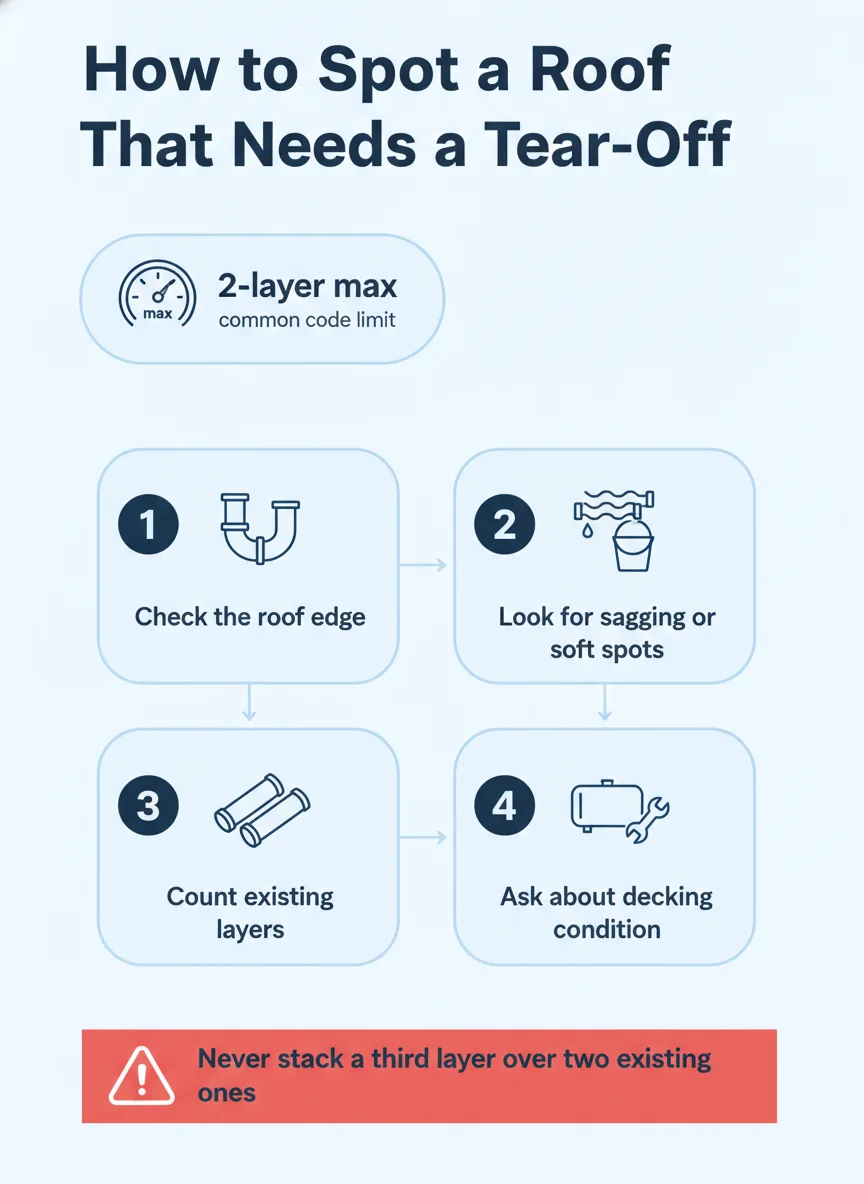
Most building departments cap roofs at two layers of shingles total, and that limit exists for structural and fire-safety reasons, not just preference. If a roof already has one layer on it, a roof-over is the last layer that code will allow. Any future work on that roof will require a full tear-off no matter what.
That matters because a homeowner choosing a layover today is also choosing to limit their options down the road. A roof already sitting on two layers, or close to it, often makes tear-off the only path forward, and a licensed crew should check permit history or do a quick count before quoting either option.
Step-by-Step: How a Tear-Off Decision Gets Made
A good roofer doesn't guess at this. The process below is how a straightforward roof assessment typically plays out before a crew recommends one approach over the other.
- Count the layers: The crew checks how many layers of shingles are already on the roof, since most codes cap it at two total.
- Check the decking: Where shingles are missing or damaged, the crew looks for visible signs of soft or rotted plywood underneath.
- Inspect the flashing: Chimney, skylight, and vent flashing gets a visual check for rust, gaps, or improper laps.
- Assess ventilation: Intake and exhaust vents get checked for blockage or undersizing that could be fixed during a tear-off.
- Review the warranty terms: The crew confirms whether the shingle manufacturer's warranty requires a single-layer install for full coverage.
- Weigh age against cost: A roof nearing the end of its expected lifespan usually points toward tear-off regardless of the layer count.
- Make the recommendation: The homeowner gets a clear read on which option fits the roof's actual condition, not just the lowest bid.
What You'll Find Once the Old Layer Comes Off
Decking Problems
It's common to find a handful of soft or delaminated sheets of decking once the shingles come off, especially around valleys, chimneys, and low-slope sections where water tends to linger. These get replaced piece by piece rather than guessed at, which is only possible once the deck is visible.
Homeowners are sometimes surprised by this discovery, but it's a normal part of a tear-off and one of the main reasons the approach exists. Catching soft decking now is far cheaper than discovering it later as a sagging ceiling or an interior leak that a roof repair alone can't solve.
Flashing and Ventilation Fixes
Old step flashing and counter-flashing around chimneys and walls often gets reused or poorly resealed during a roof-over. A tear-off gives the crew a chance to replace it correctly, which matters most in the exact spots where leaks tend to start first.
Ventilation upgrades also show up here. A roof that's never had proper attic airflow can get corrected during a tear-off, addressing issues covered in more detail in this guide on attic heat and moisture rather than sealing the problem under a second layer indefinitely.
What a Homeowner Can Check vs. What Needs a Licensed Crew
A homeowner can do some of this from the ground or the attic. Walking the attic with a flashlight to check for daylight through the roof boards, water stains on rafters, or sagging insulation gives a rough sense of whether something's wrong. Counting roof layers is sometimes possible from an attic access point too, if the edge of the decking is visible.
What a homeowner shouldn't do is get on the roof itself to inspect shingles, flashing, or decking up close. Steep pitches, loose granules, and hidden soft spots make this dangerous even for an experienced DIYer, and a fall risk isn't worth saving the cost of a professional look.
A licensed roofer brings the training to walk the roof safely, the experience to spot subtle signs of decking failure before they're obvious, and the knowledge of local code limits on layers. For anything beyond a visual check from the ground or attic, this is a job for a pro, not a weekend project.
Making the Right Call for Your Roof
There are cases where a roof-over is a reasonable, honest recommendation, usually on a roof with a single existing layer, sound decking confirmed through an attic check, and a homeowner planning to sell or move within the shingle's remaining useful years. But for most roofs reaching the end of their life in Colorado's UV and hail conditions, a tear-off is the option that protects the investment underneath the shingles, not just the shingles themselves.
If it's time to find out which option actually fits a specific roof, a direct look at the decking and flashing is the only way to know for sure, not a guess from the curb. Precise Roofing can walk through both options honestly before any work starts.
Frequently asked questions
Can you put a new roof over an old one?
In many cases a layover is physically possible as long as the roof only has one existing layer and the decking underneath is sound. Most building departments and manufacturers cap it at two layers total, and a licensed roofer should check the decking and flashing before recommending it either way.
Why do roofers recommend a full tear-off instead of a roof-over?
A tear-off lets the crew see the decking, flashing, and ventilation that a layover simply buries. Problems like soft plywood, rusted flashing, or blocked vents don't go away under a second layer, they just get harder and more expensive to fix later.
Does a roof-over void the manufacturer warranty?
It depends on the manufacturer and the specific warranty terms, so it's worth reading the fine print or asking your roofer directly. Many manufacturers rate their longest warranties for installs over a single, inspected layer of new decking, not a layover.
Is a roof-over cheaper than a tear-off?
A layover usually costs less upfront since there's no tear-off labor or disposal, but it can cost more over time if it hides damage that shortens the new roof's life. A free [inspection](/services/roof-inspections) is the only way to know which option actually makes sense for a given roof.
How many layers of shingles can a roof legally have?
Most jurisdictions limit roofs to two layers total, and plenty of older homes are already at that limit without the owner realizing it. A contractor can check the permit history or do a quick inspection to confirm how many layers are currently on the roof.