
How Long Should a Roof Last in Denver Metro?
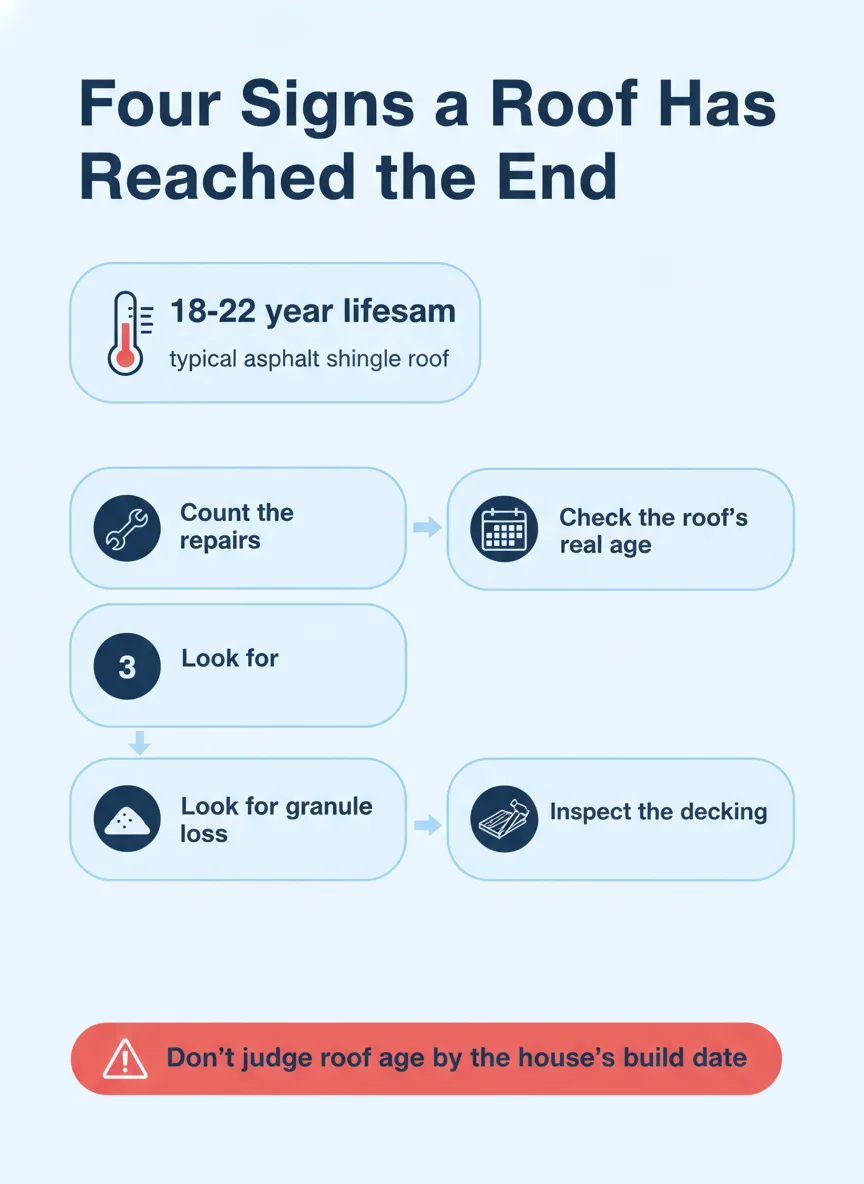
Most roofs across Denver Metro are built from asphalt shingles, and under normal sun, hail, and freeze-thaw cycling, that material typically holds up for somewhere in the range of 18 to 22 years industry-wide. Metal, tile, and flat roofing systems run on their own timelines, often longer, but every material eventually reaches a point where the question shifts from 'can this be fixed' to 'is fixing this worth it.'
The tricky part is that roof age and house age are not the same number. A roof may have been replaced partway through a home's life, or it might still be the original from construction, so the only way to know your roof's real age is through inspection history or a roofer who can read the wear patterns on the surface. That distinction matters more than almost anything else in this decision.
Why Roofs Reach a Point of No Return
A roof doesn't fail all at once. It accumulates small losses, a cracked shingle here, a loosened flashing seam there, until the system as a whole can no longer keep water out reliably even with regular maintenance. Once that threshold is crossed, a repair fixes the symptom you can see while leaving the underlying weakness in place.
Repeated Leaks in Different Spots
One leak in one location is usually a straightforward repair. But when leaks start showing up in different parts of the house, or the same general area keeps leaking again after being patched, that's a sign the roof's overall water resistance has broken down rather than one isolated component failing.
This pattern is one of the clearest signals a roof repair visit is treating a symptom instead of the cause. A thorough inspection at this stage usually finds that the shingles themselves have aged out everywhere, not just at the spot where water happens to be getting through today.
Age Combined with Storm Exposure
A roof in its first decade can usually absorb a hailstorm or a windstorm and come through with a targeted repair. The same storm hitting a roof already in its late teens often does more damage because the shingles have less flexibility and fewer granules left to protect the mat underneath.
That's why age and recent storm exposure get evaluated together rather than separately. A roof that's old and has just taken a hit is a very different conversation than a newer roof with the same storm damage, even though the visible damage might look similar from the ground.
| Sign | Repair Likely Fits | Replacement Likely Needed |
|---|---|---|
| Age of the roof | Under roughly 15 years | Near or past 20 years |
| Leak pattern | One leak, one location | Multiple leaks, multiple locations |
| Shingle condition | Isolated cracked or missing shingles | Widespread curling, cracking, or granule loss |
| Decking condition | Solid, no soft spots found | Soft or spongy decking in more than one area |
What's Actually Failing Underneath
The shingles or surface material are only the top layer. Underneath sits the decking, usually plywood or OSB, and the underlayment that acts as the backup water barrier if the surface layer ever lets moisture through. Flashing, the metal pieces around chimneys, skylights, and roof-wall transitions, seals the spots where a flat surface meets a vertical one.
When a roof is past repair, it's rarely just the shingles. Water that's been getting past worn shingles for a season or two often reaches the underlayment and starts working on the decking itself, and once decking is soft or delaminating, no amount of surface-level patching restores its structural value. That's the layer that turns a roofing decision into a safety decision.
Step-by-step: How We Evaluate a Roof's Remaining Life
A real evaluation covers more than a glance from the ground. Here's the general order most roofers work through on a thorough inspection.
- Check the roof's age: We confirm the actual install date through records or wear patterns, since the house's age doesn't tell you anything reliable about the roof's age.
- Walk the full surface: We cover every slope and valley, not just the areas visible from a ladder at the edge, since problem spots often hide in low-traffic areas.
- Test the decking: We check for soft or spongy spots underfoot, which signal moisture has already reached the wood beneath the shingles.
- Count the failure points: We log every area showing cracking, curling, granule loss, or flashing separation to see whether the damage is isolated or spread across the roof.
- Review the attic: Interior staining, damp insulation, or daylight through the decking confirms whether water has already made it past the roofing system.
- Weigh repair against replacement: We compare the cost and durability of patching every failure point against a full replacement's lifespan, then lay out both options plainly.
What the Signs Usually Mean
Granule Loss and Bald Spots
Asphalt shingles are coated in granules that shield the asphalt mat underneath from UV exposure. As a roof ages, those granules wear off and collect in gutters or downspouts, leaving bald patches where the mat is exposed directly to sun and weather.
A few bald spots on an otherwise young roof are often a maintenance item. Widespread granule loss across most of the roof surface, especially paired with shingles that feel brittle to the touch, usually means the asphalt itself has oxidized and lost the flexibility it needs to keep sealing properly.
Soft Decking and Multiple Layovers
Soft or spongy decking almost always means water has been sitting against the wood long enough to start breaking it down. This is one of the few signs that moves a roof from 'repair candidate' to 'replacement candidate' on its own, because decking has to be solid for any new roofing material to be installed correctly.
A prior layover, where a new layer of shingles was installed directly over an old one instead of a full tear-off, adds weight and traps moisture between the layers. A roof with one layover already in place has less margin left before a repair stops being enough, since the structure underneath has already absorbed extra load for years.
DIY vs. Calling a Pro
There are a few things a homeowner can reasonably check without climbing on the roof. Looking at granules collecting in the gutters, watching for daylight or staining in the attic, and noting how old the roof is from any paperwork on file are all useful first steps that don't require special equipment or training.
Everything beyond that calls for a licensed roofer. Walking the roof surface safely, testing decking for soft spots, and reading flashing wear accurately all require experience most homeowners don't have reason to build up, and getting it wrong on a roof surface carries real fall risk. A free inspection removes the guesswork without any cost to find out where you stand.
The decision between repair and replacement also has a cost side that's worth discussing honestly with whoever is doing the inspection. A roofer who explains why a repair will or won't hold up, rather than just quoting a number, is giving you the information you actually need to make the call.
Making the Call on Your Roof
Most of these signs rarely show up alone. A roof nearing 20 years with granule loss in several spots, a recent leak, and a prior layover is telling a consistent story, even if any one of those signs by itself might have been a simple patch a decade earlier. Reading them together is what separates a sound repair decision from a short-term fix that costs more down the line.
If you're not sure which side of that line your roof falls on, a free roof inspection is the fastest way to find out, and homeowners across Littleton and the rest of Denver Metro can also read our breakdown of repair vs. replace and how to tell for more on how that decision plays out in practice. Precise Roofing has been walking roofs across the region for more than 20 years and can tell you plainly which side of that line yours is on.
Frequently asked questions
How do I know if my roof is too old to repair?
A roof is usually too old to repair when it's near or past its material's expected lifespan and is showing more than one failure point at once, like curling shingles plus a soft spot on the decking. One isolated issue at that age can often still be patched, but multiple issues together usually point to replacement.
Does the age of my house tell me the age of my roof?
No, and this is one of the most common mix-ups homeowners make. A roof may have been replaced years after the house was built, or it could be the original roof from construction, so the only reliable way to know its true age is a roofer's inspection or your own repair and replacement records.
Is it ever cheaper to keep repairing an old roof?
It can be cheaper in the short term, but repeated repairs on a roof near the end of its life often cost more over a few years than one replacement would have, especially once decking damage or interior repairs get added in. A free inspection can tell you where your specific roof falls on that line.
What happens if I ignore the signs and wait too long?
Waiting too long usually turns a roof problem into a structural one, since water that gets past failing shingles or flashing can soften decking, rot framing, and damage insulation and drywall underneath. Catching the signs early keeps the fix contained to the roof itself.
Can a roof look fine from the ground but still be past repair?
Yes, some of the most telling signs, like soft decking or granule loss in the valleys, aren't visible from the ground or even from a ladder at the edge. That's why a hands-on inspection across the whole roof surface matters more than a quick visual check from the driveway.