
Why the Adjuster Appointment Matters So Much in Colorado
Colorado's Front Range and eastern plains see some of the most frequent hail activity in the country, which means a lot of homeowners in Denver, Colorado Springs, and the towns in between end up filing a roof claim at some point. The adjuster appointment is the single moment where your insurance company decides how much damage your roof actually has and how much they're willing to pay to fix it.
Because so much rides on that one visit, it's worth treating it like an appointment you prepare for rather than something that just happens to you. Homeowners who show up with documentation and a roofer who knows what to look for tend to get a far more accurate assessment than those who let the adjuster walk the roof alone.
What the Adjuster Is Actually Looking For
An insurance adjuster isn't a roofer. Their job is to assess damage against the policy's language, not to recommend the best long-term fix for your roof. Understanding that distinction helps explain why having a roofer present changes the outcome of so many claims.
The Test Square
Most adjusters mark off a section of roof, commonly around 10 feet by 10 feet, and count the hail hits or wind-damaged shingles inside that square. That count gets extrapolated to estimate the damage across the whole roof slope.
The problem is that damage on a roof is rarely even. Hail often hits harder on one slope than another depending on wind direction during the storm. If the test square lands on a lighter-hit area, the estimate can come back lower than the real damage across the roof. A roofer walking the roof alongside the adjuster can point toward the areas that took the worst of the storm.
Collateral and Code-Required Damage
Adjusters also look at collateral damage, things like dented gutters, damaged vents, soft metal flashing, and any related Gutters components that took a hit along with the roof. Some of these are easy to overlook if you're not trained to spot them.
They also need to account for code-required items, meaning materials or components that building code requires be updated even if they weren't directly damaged, such as updated flashing or ventilation brought up to current code during a full tear-off. A roofer familiar with local code is in a better position to flag these than a homeowner walking the roof for the first time.
| Without Your Roofer Present | With Your Roofer Present | Why It Matters |
|---|---|---|
| Test square placed anywhere on the roof | Test square guided toward the worst-hit slope | Damage count reflects the real condition of the roof |
| Collateral damage may go unnoticed | Vents, flashing, and gutters get flagged | Fewer items missed from the final estimate |
| Code-required upgrades may be skipped | Code items identified and documented | Avoids paying out of pocket later for required work |
| Technical terms go unquestioned | Roofer speaks the adjuster's language | Fewer misunderstandings in the written estimate |
What to Have Ready Before the Adjuster Arrives
The appointment goes faster and more accurately when you walk in with paperwork in hand instead of trying to remember details on the spot. The goal is to give the adjuster a clear, documented timeline of the storm and the damage, not just a verbal description.
This is also where a prior Roof Inspections report helps, since it establishes the roof's condition before the storm happened and makes the storm-related damage easier to isolate from normal wear.
Step-by-step: Preparing for the Adjuster Appointment
Most of this preparation takes less than an hour and can be done in the days leading up to the scheduled visit.
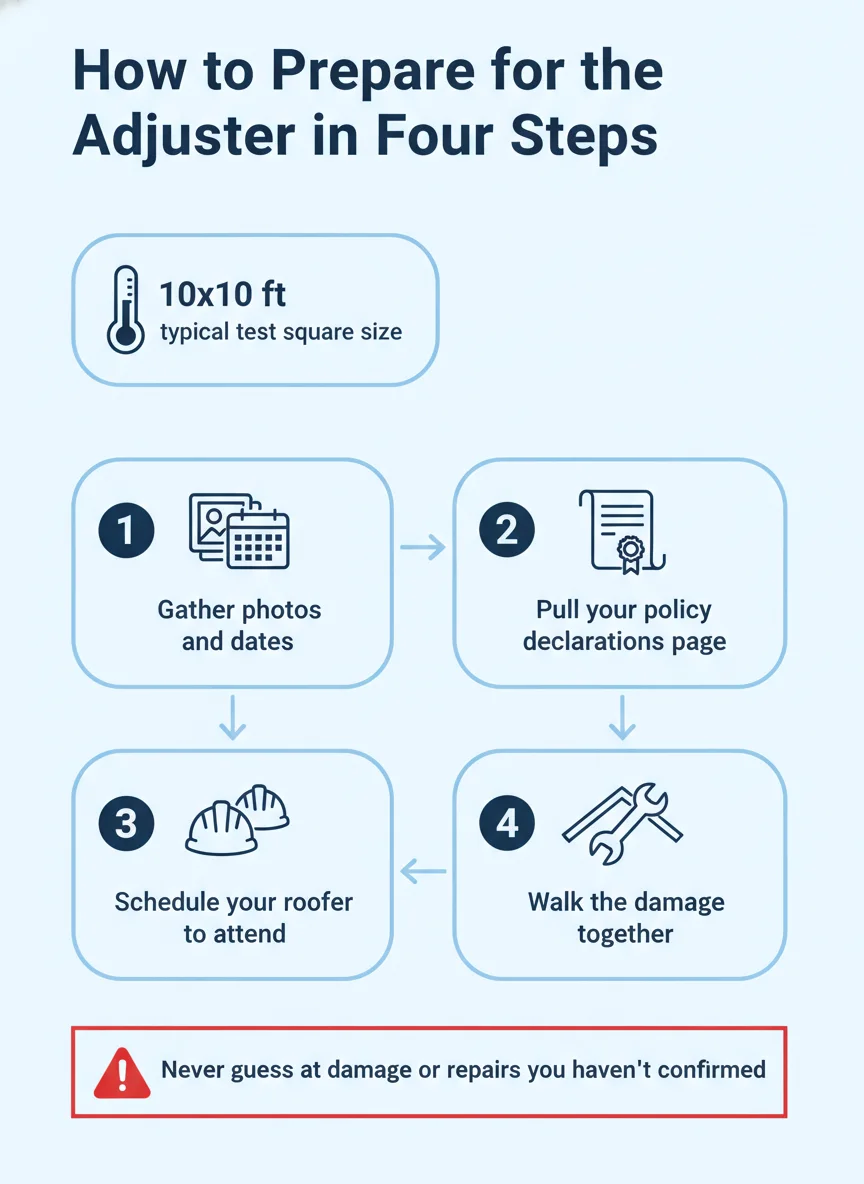
- Pull your policy: Find your declarations page so you know your coverage, your deductible, and any endorsements that apply to roof claims.
- Gather storm photos: Collect any photos or videos taken right after the storm, including yard debris, hail on the ground, or visible roof damage.
- Note the storm date: Write down the approximate date of the storm, since carriers often cross-reference weather data to confirm the claim.
- Schedule your roofer: Set the adjuster appointment at a time your roofer can also attend, rather than scheduling it without coordinating first.
- Walk the exterior together: Before the adjuster climbs up, walk the ground level with your roofer to point out any visible siding or gutter damage.
- Keep a written record: Take notes during the appointment on what was measured, what was found, and any verbal estimates mentioned.
What Happens During the Appointment Itself
On the Roof
The adjuster and your roofer typically walk the roof together, measuring slopes, checking the test square, and photographing anything that looks like storm damage. This is the point where having a second set of trained eyes matters most, since a roofer who inspects damaged roofs regularly can recognize patterns the adjuster might read differently.
If there's a disagreement about what counts as storm damage versus wear from age, this is where it gets discussed directly, with both parties looking at the same section of roof at the same time rather than comparing notes after the fact.
After the Walk
Once the inspection wraps up, the adjuster usually explains what they found and gives a general sense of what the estimate will include. This isn't the final number, it's a starting point that goes back to the insurance company for processing.
Your roofer can use this conversation to flag anything they noticed but the adjuster didn't mention, which becomes useful later if a supplement needs to be filed. Our Storm & Hail Damage process includes documenting these details in writing the same day.
What You Can Handle Yourself vs. What Needs a Roofer
Homeowners can absolutely handle the paperwork side on their own: pulling the policy, organizing photos, and keeping notes from every phone call with the insurance company. None of that requires a license or special training, just organization.
What's harder to handle alone is the technical walk-through of the roof itself. Telling the difference between storm damage, manufacturing defects, and years of normal wear takes an experienced eye, and getting that wrong in either direction can cost you money, either by underreporting damage or by having a claim denied for items that aren't actually storm-related.
That's the piece worth bringing in a licensed roofer for. If a Roof Repair ends up being the right call instead of a full tear-off, a roofer present at the inspection can make that case directly to the adjuster instead of it getting lost in paperwork later.
Getting Ready for Your Next Adjuster Appointment
The adjuster appointment doesn't have to feel like something that happens to you. With your paperwork organized and a roofer standing next to you on the roof, it becomes a conversation between two people who both know what they're looking at, which almost always leads to a more accurate outcome.
If you've got a storm claim coming up and want someone who's walked this process before alongside you, Precise Roofing documents the damage, meets the adjuster on site, and stays with the claim through the final install.
Frequently asked questions
Should my roofer be there when the insurance adjuster inspects my roof?
Yes, having your roofer on the roof with the adjuster is one of the most useful things you can do during a claim. A roofer who inspects roofs daily can point out damage the adjuster's test square might miss and speak the same technical language the adjuster uses.
What does the insurance adjuster actually measure on my roof?
The adjuster typically marks off a small test square, often around 10 feet by 10 feet, and counts the hail hits or wind damage inside it. That sample gets used to estimate damage across the entire roof, so where the square lands matters.
What should I bring to the adjuster appointment?
Bring any photos you took of the damage right after the storm, the approximate date of the storm, and your policy's declarations page showing your coverage. Our team can also provide our own [Storm & Hail Damage](/services/storm-hail-damage) documentation to compare against the adjuster's findings.
What happens if my roofer's estimate doesn't match the adjuster's estimate?
A gap between estimates is common and usually gets resolved through supplemental documentation rather than a dispute. Your roofer can submit additional photos, measurements, or code-required items that were missed, and most carriers will review a well-documented supplement.
How long does the adjuster appointment usually take?
Most roof inspections by an adjuster take somewhere between 30 minutes and an hour, depending on the roof's size and how much damage is found. Complex roofs or roofs with multiple slopes and penetrations can run longer.