
Two Warranties, One Roof
Every new roof installed in Colorado comes bundled with two separate pieces of paper, and a lot of homeowners never read either one until something goes wrong. The manufacturer warranty covers the material. The workmanship warranty covers the labor. They are not the same document, they are not issued by the same party, and they do not cover the same failures.
This matters more in a state with Colorado's weather swings, where a roof takes hail, UV, wind, and freeze-thaw cycling all in the same year. When something fails, the first question an adjuster or a second opinion will ask is whether the problem is a material defect or an installation error. Knowing the answer, and knowing which warranty applies, decides who pays to fix it.
Why the Two Warranties Exist Separately
A roofing system has two points of failure: the product and the installer. Manufacturers only control what happens in their factory, so they will only stand behind defects that originate there. Everything that happens on the roof, from flashing details to nail placement to ventilation, is on the installer, which is why a separate workmanship warranty exists to cover that half of the job.
What the Manufacturer Warranty Actually Covers
Manufacturer warranties cover defects in the shingle, underlayment, or other material itself, things like premature granule loss from a bad batch, or a product that fails to perform as advertised under normal conditions. They are typically prorated after an initial full-coverage period, meaning the payout shrinks the older the roof gets.
What they do not cover is installation error. If a shingle blows off because it was fastened incorrectly, that is not a material defect, even if the manufacturer made the shingle. Manufacturers also exclude damage from severe weather events in most cases, which is why storm & hail damage claims usually route through your homeowner's insurance policy instead.
What the Workmanship Warranty Actually Covers
A workmanship warranty is the installer's promise that the roof was put together correctly, and it is the document that matters most when a leak shows up two years after a roof replacement. If water gets in because flashing was cut short or a vent boot was set wrong, that is a labor issue, and it falls on whoever installed the roof.
Unlike manufacturer coverage, workmanship warranty terms are set entirely by the individual roofing company. There is no industry standard length or scope, which is exactly why you want it spelled out in writing before signing a contract, not described verbally during the sales pitch.
| Manufacturer Warranty | Workmanship Warranty | |
|---|---|---|
| Who issues it | The shingle or material maker | The roofing company that installed it |
| What it covers | Factory defects in the material | Errors in how the roof was installed |
| Typical term | Set by manufacturer, often prorated over time | Set by the installer, varies company to company |
| Common voids | Poor ventilation, unregistered system, improper repair | Repairs or alterations by another contractor |
The System Behind the Shingle
A roof is not just the visible layer. Underlayment, flashing, ventilation, and fasteners all work together, and most manufacturer warranties actually require the full system, meaning compatible underlayment and accessories, to qualify for full coverage. Mixing and matching products from different manufacturers can reduce or eliminate coverage even if every individual piece is defect-free.
Ventilation is the piece homeowners overlook most. A roof deck that runs hot because intake and exhaust vents are undersized or blocked can bake shingles from underneath, and manufacturers treat that as an installation and maintenance issue, not a material flaw, which puts it outside their warranty entirely.
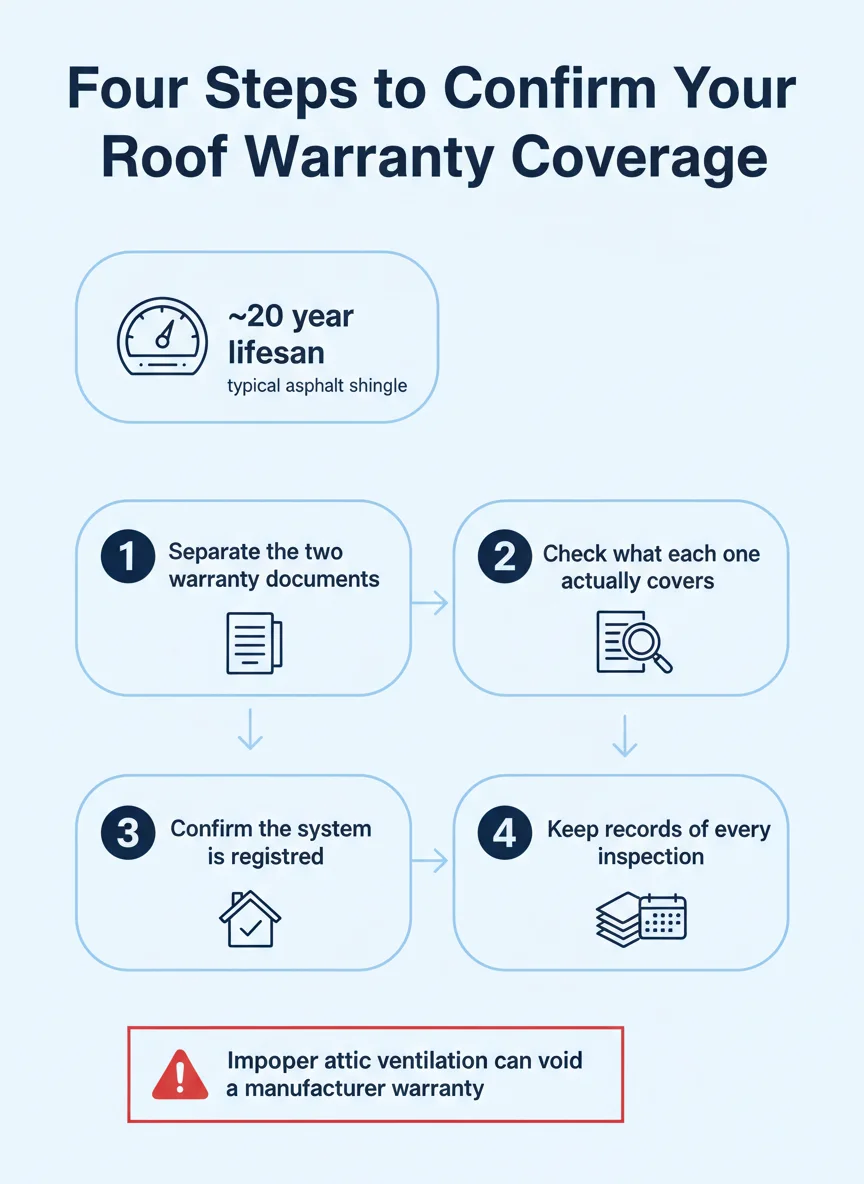
Step-by-step: Confirming Your Roof Warranty Is Actually in Effect
Warranty coverage is not automatic just because a job was done well. A few paperwork steps after installation are what actually activate and protect the coverage long term.
- Get both documents in writing: Ask for the manufacturer's warranty certificate and the installer's workmanship warranty as separate documents before the final payment, not a verbal summary of either one.
- Register the system: Many manufacturer warranties require registration within a set window after installation to activate full coverage, so confirm who is responsible for filing it.
- Save the material list: Keep a record of exactly which shingles, underlayment, and accessories went on your roof, since this is what the manufacturer will ask for if you ever file a claim.
- Note the ventilation setup: Confirm your installer documented the attic ventilation calculations, since inadequate airflow is one of the most common reasons manufacturers deny claims.
- Schedule periodic checks: A yearly look at flashing, vents, and fasteners catches small workmanship issues before they turn into a leak that's harder to trace back to its cause.
- Keep every inspection record: Documentation from a roof inspection builds a paper trail that supports a warranty claim if a dispute ever comes up over when a problem started.
What Homeowners Usually Find When a Claim Gets Disputed
Most warranty disputes come down to one question: did this fail because of the material or because of the install. The answer is not always obvious from the ground, which is why documentation from the original job and any follow-up inspections carries real weight.
When It Points to the Manufacturer
Signs that point toward a material defect include granule loss in an isolated pattern unrelated to age or sun exposure, shingles that crack along a seam rather than at a stress point, or a batch of shingles that all fail the same way across the same section of roof while adjacent shingles from a different run hold up fine.
If this is what you're seeing, the manufacturer will typically want photos, the batch or lot number if available, and documentation of when the roof was installed and by whom before they'll process a claim.
When It Points to the Installer
Leaks concentrated around flashing, valleys, or penetrations like vents and chimneys usually point to installation rather than material. So does uneven wear that follows the layout of the fastening pattern rather than sun exposure, or a leak that shows up in the first year or two rather than near the end of the roof's expected life.
These cases go back to the original installer under the workmanship warranty, which is why keeping that contractor's contact information and contract on file matters as much as the manufacturer's paperwork.
What You Can Check Yourself vs What Needs a Licensed Roofer
A homeowner can do a surprising amount of the warranty-protection work without climbing a ladder. Reading the actual warranty documents, confirming registration was filed, keeping receipts and inspection reports organized, and doing a visual check from the ground after a storm are all reasonable for anyone to handle.
What you shouldn't do yourself is diagnose whether a failure is material or workmanship, or attempt a repair in hopes of saving money before filing a claim. Both manufacturer and workmanship warranties generally require that any repair work be done by a licensed roofer, and a DIY patch can void coverage even on a legitimate claim.
A licensed roofer can also document the condition of the roof in a way that holds up if a claim gets disputed, which matters whether the issue is a straightforward roof repair or something larger. That documentation is often the difference between a claim that gets approved in one round and one that drags out.
Get the Paperwork Before You Need It
The best time to understand your warranty coverage is the week the roof goes on, not the week it starts leaking. Ask for both documents in writing, confirm what voids each one, and file the registration paperwork before it slips through the cracks. If you're weighing options for a home in Littleton or anywhere else in the region, ask any roofer you're considering to walk through their workmanship terms before you sign anything.
If you're trying to sort out whether a current issue falls under a material defect or a labor issue, pairing that question with a look at when a roof is past repair will help you figure out which direction the conversation should go. Precise Roofing can walk you through both warranties on any new installation and help you sort out which one applies if a problem comes up later.
Frequently asked questions
What is the difference between a manufacturer warranty and a workmanship warranty?
A manufacturer warranty covers defects in the roofing material itself, like a shingle that cracks or curls from a factory flaw. A workmanship warranty covers the installation, so if a leak traces back to how the roof was put together rather than the material, the installer is on the hook, not the manufacturer.
Does a roof warranty transfer to a new homeowner?
Many manufacturer warranties do transfer if the registration is updated within a set window after the sale, though terms vary by manufacturer. Workmanship warranties depend entirely on what the installer put in writing, so ask for the paperwork before you buy a house with a roof under warranty.
What voids a roof warranty?
The most common culprits are inadequate attic ventilation, a layover installed on top of old material instead of a full tear-off, and skipping the manufacturer's registration step. Unapproved repairs by someone other than a licensed roofer can also void coverage.
How long does a workmanship warranty usually last?
It depends entirely on the installer, since there is no industry-standard length the way there is for material warranties. Get the specific term in writing before the job starts rather than assuming it matches the manufacturer's coverage.
Can I file a warranty claim myself or do I need my roofer?
You can usually contact the manufacturer directly for a material defect, but most manufacturers ask for documentation from a licensed installer to process the claim. For workmanship issues, you go straight to the roofer who installed the system.