
Why Colorado Homeowners Keep Hearing About Class 4 Shingles
If you've lived along the Front Range for more than a season, you've probably had at least one hailstorm roll through hard enough to dent a car hood or shred patio umbrellas. That kind of weather is exactly why Class 4 impact-resistant shingles come up so often in conversations between homeowners, roofers, and insurance adjusters across Denver Metro and the surrounding towns.
The term gets used loosely, though, and that's where confusion creeps in. A roofer might mention it during a roof inspection, an insurance agent might ask about it on a policy renewal, and a neighbor might swear it saved their roof after the last big storm. Before you decide whether the upgrade makes sense for your home, it helps to know exactly what the rating tests and what it doesn't.
What the Class 4 Rating Actually Tests
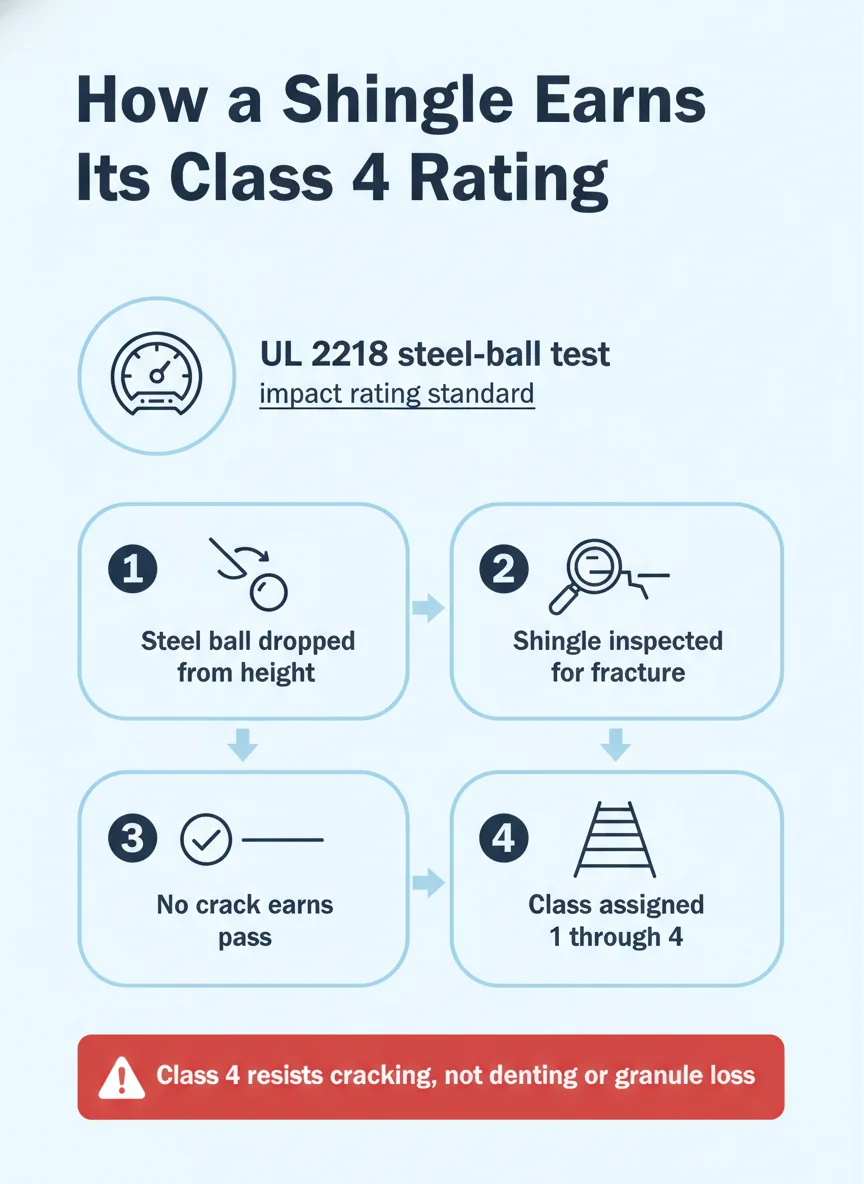
The rating comes from a standardized lab test called UL 2218, which measures how a roofing material holds up against simulated impact. Shingles are rated Class 1 through Class 4, with Class 4 representing the highest level of impact resistance in the test.
How the Test Works
In the test, a steel ball of a specified size is dropped from a set height onto the shingle, and the shingle is examined for cracking, splitting, or tearing on the underside. A shingle that shows no fracture after multiple impacts earns the higher class rating, with Class 4 requiring it to withstand the largest ball size tested.
It's a repeatable, controlled test, which is useful for comparing products side by side. But a lab drop test with a steel ball is still a simplified stand-in for the countless shapes, speeds, and angles that real hailstones bring with them during an actual Colorado storm.
What the Rating Does Not Promise
A Class 4 rating does not mean the shingle is immune to hail damage. Large hailstones, hail driven by high wind, or hail that hits a weak spot like a nail head or a previously bruised section of roof can still cause problems even on a rated product.
It also doesn't address every type of damage a storm can cause. Granule loss, bruising that doesn't show on the surface, and damage to flashing, vents, or gutters all fall outside what the impact test measures. A roof can carry a Class 4 label and still need a storm and hail damage inspection after a severe event.
| Rating | What It Resists | What It Doesn't Address |
|---|---|---|
| Class 1-2 | Basic impact at lower force | Moderate to severe hail, granule loss |
| Class 3 | Moderate impact resistance | Large hailstones, wind-driven impact |
| Class 4 | Highest lab-tested impact resistance | Hail-proofing, flashing and gutter damage |
What a Class 4 Shingle Is Actually Made Of
Most impact-resistant shingles reach their rating through a reinforced mat or a modified asphalt layer designed to flex rather than crack on impact. The goal is to let the shingle absorb and distribute the force of the hit instead of letting it fracture the material outright.
These shingles are still asphalt shingles at their core, installed the same way as a standard architectural shingle, with the same underlayment, flashing, and ventilation requirements underneath. The impact resistance is built into the shingle itself, not into some separate system layered on top of a typical roof.
Step-by-Step: How to Check If Your Roof Already Has Class 4 Shingles
Before you spend money assuming your roof needs an upgrade, it's worth taking a few minutes to check what's already up there. Here's a simple way to find out.
- Pull your paperwork: Check the original install invoice, warranty card, or permit paperwork for the shingle manufacturer and model name.
- Search the shingle name: Most manufacturers list the impact class rating for each shingle line on their product page or spec sheet.
- Check for leftover bundles: If any extra shingles were left in the attic or garage after the install, the wrapper usually prints the class rating directly.
- Look at the shingle itself: Some manufacturers stamp a class rating code on the back of the shingle tab, visible if a piece has come loose.
- Ask during an inspection: A trained eye can often identify the shingle line by its profile and pattern during a roof inspection.
- Confirm with your roofer: If none of the above turns up an answer, a roofer can identify the product on site and tell you definitively.
How Insurers and Adjusters Treat the Class 4 Rating
Possible Premium Consideration
Some insurance carriers offer a discount or credit for homes with impact-resistant roofing installed, since the logic is that a more resistant roof means fewer claims over time. This isn't universal, though, and the details vary a lot from one carrier and policy to the next.
If you're considering the upgrade partly for the potential insurance benefit, call your agent before you commit to the material. Ask specifically whether your policy recognizes the rating and what documentation they'll need to apply any credit.
Claims After a Storm
Having Class 4 shingles doesn't change how a claim gets filed after a hailstorm. An adjuster still needs to see documented damage to approve a claim, and a rated shingle that shows bruising or cracking after a severe storm is treated the same as any other damaged roofing material.
If a storm rolls through and you're not sure whether your roof held up, a documented inspection matters more than the label on the shingle. Our Hail or Wind Damage After a Storm guide walks through what to look for and when to call someone out.
DIY vs Calling a Pro
Checking your paperwork or searching a shingle model online is something any homeowner can do from a kitchen table, and it's a reasonable first step before deciding whether an upgrade is worth exploring. There's no risk in doing that research yourself.
Getting up on the roof to identify a shingle by sight, or checking for impact damage after a storm, is a different matter. Roof surfaces get slick, especially after rain or snow, and spotting subtle bruising or a cracked mat takes a trained eye that knows what a true impact fracture looks like versus normal wear.
If you're weighing a full roof replacement and trying to decide whether Class 4 shingles are worth the upgrade for your specific home, that's a conversation worth having with a licensed roofer who can walk you through your options in person rather than guessing from a spec sheet.
Is the Upgrade Worth It for Your Home?
Whether Class 4 shingles make sense comes down to your hail exposure, how long you expect to stay in the house, and what your insurance carrier offers in return. For homes across the Denver Metro area, where hail is a regular part of the weather pattern, the upgrade is a reasonable question to raise the next time you're replacing a roof.
It's not a decision to make off a marketing claim, though. Ask to see the actual shingle rating, confirm it with the manufacturer if needed, and get a straight answer about what it does and doesn't protect against. Precise Roofing can walk you through the options during a free inspection and help you decide if the upgrade fits your home and your budget.
Frequently asked questions
What does a Class 4 shingle rating actually mean?
It means the shingle passed a lab test where a steel ball is dropped onto it repeatedly without the shingle fracturing or splitting. It's a measure of impact resistance under a controlled test, not a guarantee against all hail damage.
Are Class 4 shingles hail-proof?
No, nothing on a roof is truly hail-proof. Class 4 shingles are built to resist cracking and granule loss better than standard shingles, but large or fast-moving hail can still bruise or mark them.
How can I tell if my roof already has Class 4 shingles?
Check your original invoice or paperwork from the install, since the shingle name and class rating are usually listed there. You can also look at the shingle wrapper if any leftover bundles were stored, or check for a stamp printed on the back of a shingle tab.
Do insurance companies give discounts for Class 4 shingles?
Some insurers offer a premium discount for impact-resistant roofing, but this varies by carrier and policy, so the only way to know for certain is to ask your agent directly. Don't assume a discount applies just because the shingle carries the rating.
Do Class 4 shingles cost more than standard shingles?
Generally yes, since the manufacturing process and materials used to pass the impact test tend to cost more than a standard shingle. Whether the upgrade is worth it depends on your hail exposure, how long you plan to stay in the home, and whether your insurer rewards the upgrade.