
Why Colorado roofs need a season-by-season plan
A roof in Denver or along the Front Range deals with more weather variety in a single year than most parts of the country see in three. Spring brings fast-moving hail cells, summer brings intense high-altitude UV, fall brings wind and falling leaves, and winter brings hard freezes and heavy snow loads. Each season stresses the roof differently, and a problem that starts small in April can turn into a ceiling stain by December if nobody looks at it in between.
That's why a single annual inspection often isn't enough here. A seasonal mindset, checking different things at different times of year, catches issues while they're still a quick fix. This calendar walks through what to look for each season, what each season tends to reveal, and when it makes sense to call in a roof inspection instead of guessing from the ground.
Why timing matters more than frequency
It's not just about how often you check your roof, it's about checking the right things at the right time. A gutter check in July won't tell you much, because leaves haven't fallen yet. An inspection for hail bruising in December is pointless if the last storm was in June. Matching the check to the season is what actually catches problems early.
What spring and summer checks are built for
Spring and early summer checks exist to catch storm damage fast. Hail can crack shingles or knock granules loose without leaving an obvious hole, and that kind of bruising weakens the roof's ability to shed water long before a leak shows up inside. Catching it right after a storm, rather than months later, is what Storm & Hail Damage inspections are built around.
Summer heat does slower, quieter damage. Months of intense UV exposure dry out asphalt shingles and cause granules to shed at a faster rate, especially on south and west-facing slopes that get the most direct sun. A summer check is less about storm damage and more about wear, looking for curling edges, bald patches, and brittle shingles before they crack.
What fall and winter checks are built for
Fall checks are about clearing the way for winter. Leaves, needles, and debris pile up in valleys and gutters through autumn, and if they're still there when the first freeze hits, they trap water against the roof deck instead of letting it drain. This is the single most preventable cause of winter leaks on a Colorado roof.
Winter checks focus on snow load, ice, and attic heat loss. Heavy wet snow adds real weight to a roof structure, and uneven melting from poor attic ventilation is what creates ice dams at the eaves. A winter check is less hands-on and more observational, watching for icicles, dark streaking under snow, or sagging along the roofline.
| Season | Main risk | What to check |
|---|---|---|
| Spring | Hail and wind damage | Bruised or missing shingles, dented flashing, debris on the roof |
| Summer | UV wear and heat | Curling shingles, granule loss, attic temperature and ventilation |
| Fall | Clogged gutters and debris | Gutters, downspouts, valleys, and loose shingles before freeze |
| Winter | Ice dams and snow load | Icicles, uneven melt patterns, sagging, interior ceiling stains |
The parts of the roof doing the most work each season
Flashing around chimneys, vents, and skylights takes the brunt of seasonal expansion and contraction, since metal and roofing material heat and cool at different rates throughout the year. A gap that opens up in summer heat can become a winter leak once snow sits against it. Gutters and downspouts do the heaviest lifting in fall and spring, moving meltwater and storm runoff away from the foundation and roof edge.
The attic plays a bigger seasonal role than most homeowners realize. In summer, poor attic ventilation traps heat that bakes shingles from underneath. In winter, that same trapped heat melts snow unevenly on the roof surface, which is the mechanism behind most ice dams. Checking attic insulation and airflow once a year addresses both problems at once.
Step-by-step: running your own seasonal roof check
A homeowner can safely do a ground-level and attic check each season without ever getting on the roof. Here's the order that catches the most, fastest.
- Walk the perimeter: Look up from the ground after any storm for missing shingles, dented vents, or debris caught in valleys.
- Check the gutters: In spring and fall especially, look for sagging gutters, standing water, or granules piling up in the downspout.
- Scan for streaking: Dark streaks or stains on the ceiling or in the attic usually mean water is getting past the roofing material somewhere.
- Check attic ventilation: Feel for excess heat in summer or frost buildup in winter, both signs of poor airflow.
- Look at flashing points: Binoculars work fine here, check chimneys, skylights, and vent pipes for gaps or lifted edges.
- Note snow and ice patterns: Uneven melting or icicles forming at the eaves in winter can point to heat loss or an ice dam starting.
- Call for a closer look: Anything that looks off from the ground is worth a professional inspection before it becomes a bigger repair.
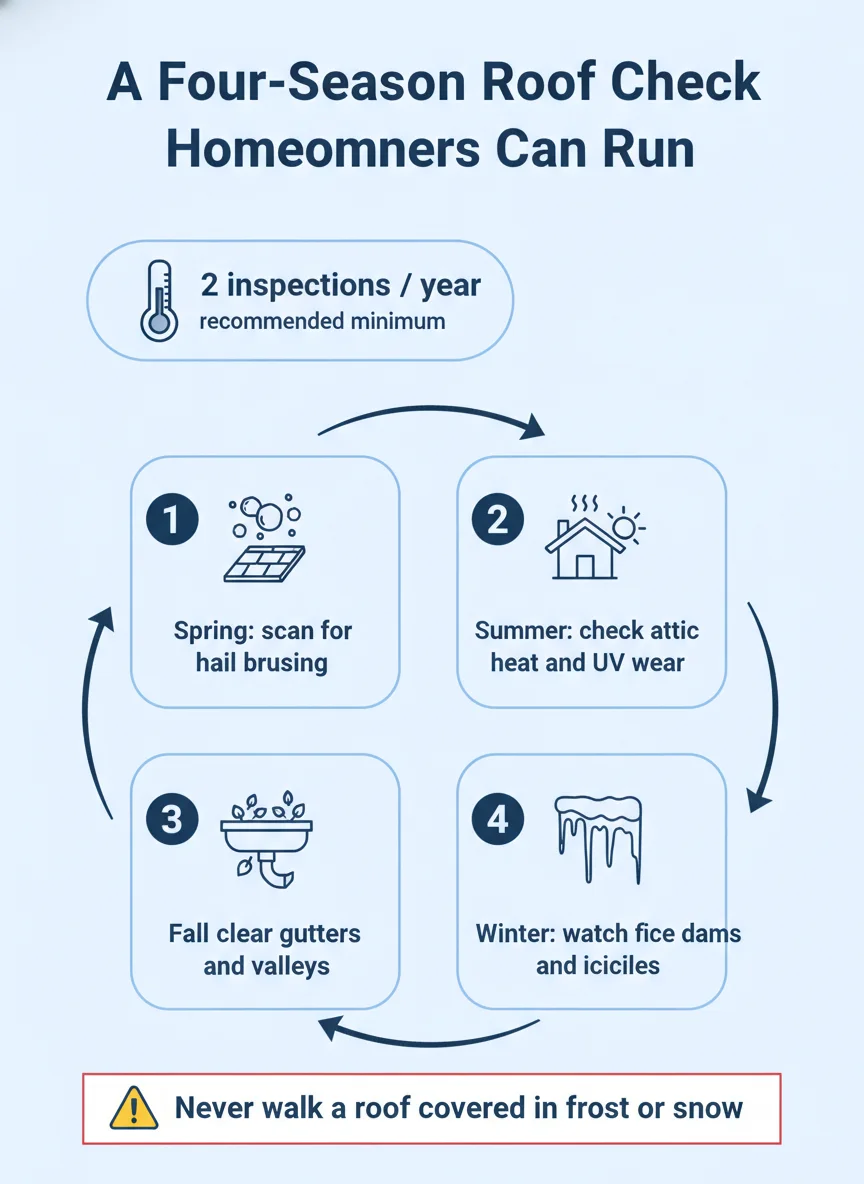
What each season's check usually turns up
Spring and summer findings
Spring checks after hail season most often turn up bruised shingles, which look like soft dark spots where granules have been knocked loose, or small punctures in softer materials like flat roofing membranes. These aren't always visible from the ground, which is why a post-storm check is worth doing even when nothing looks obviously wrong.
Summer checks tend to reveal the slower kind of damage, curling shingle edges, bald spots where granules have worn thin, and warm attics that suggest ventilation isn't keeping up. None of these are emergencies on their own, but they're exactly the kind of wear that shortens a roof's overall lifespan if left unaddressed.
Fall and winter findings
Fall checks most often turn up clogged gutters and debris sitting in roof valleys, both of which trap water right where the roof needs to drain fastest. Loose or lifted shingles found in fall are worth fixing before winter wind and snow load make them worse.
Winter checks tend to reveal the results of problems that started earlier in the year, ice dams forming where attic heat has melted snow unevenly, or interior ceiling stains that trace back to a flashing gap nobody caught in fall. By the time snow and ice are involved, a roof repair visit is often the fastest way to stop active water intrusion.
What homeowners can check themselves vs. what needs a pro
Ground-level and attic checks are well within reach for most homeowners. Looking for missing shingles with binoculars, clearing visible gutter clogs from a stable ladder, and checking attic insulation depth and ventilation are all reasonable DIY tasks that don't require special equipment.
Anything that requires getting on the roof itself, especially a steep pitch, a multi-story home, or any roof with ice or frost present, is better left to a licensed crew with the right harness and footing equipment. Diagnosing flashing failures, hail bruising, or the actual source of a leak also takes an experienced eye, since the spot where water shows up inside often isn't where it's actually getting in.
A good rule of thumb: if the check can be done safely from the ground, a ladder on solid footing, or inside the attic, it's reasonable for a homeowner to handle. If it requires walking the roof surface or diagnosing a leak's actual source, it's worth bringing in a professional before guessing causes more damage.
Building the habit before the next storm hits
The homeowners who get the most life out of their roof aren't the ones with the newest materials, they're the ones who check it on a schedule instead of waiting for a leak to force the issue. A spring check after hail season and a fall check before the first freeze cover most of what matters, with attic checks filled in during summer and winter.
If it's been more than a year since anyone has had eyes on your roof, or you can't remember the last time someone checked the attic ventilation, that's a good sign it's time for a look. Precise Roofing offers a free inspection year-round for homeowners across the Denver Metro who want a clear read on where their roof stands before the next season turns.
Frequently asked questions
How often should I have my roof inspected in Colorado?
Most roofers recommend two inspections a year, once in spring after the winter freeze and once in fall before snow returns. A quick check after any major hail or wind event is also a good idea, since damage isn't always visible from the ground.
What time of year is hardest on a Colorado roof?
Spring through early summer tends to be the toughest stretch, with hail and high wind events clustering from April through June along the Front Range. Summer sun and intense UV exposure add a second round of wear even without storms.
Do ice dams happen everywhere in Colorado?
Ice dams form where heat escapes from the attic and melts snow on the roof, which then refreezes at the colder eaves. They're more common on homes at higher elevation or with poor attic ventilation, and less of a concern on well-insulated homes at lower elevation.
Can I inspect my own roof instead of calling a roofer?
You can do a visual check from the ground or a ladder for obvious problems like missing shingles or sagging gutters, but a trained eye catches things homeowners miss, like cracked flashing or granule loss. A free inspection is a low-risk way to get a second opinion.
What should I check on my roof before winter hits?
Before the first hard freeze, clear gutters and downspouts, check attic insulation and ventilation, and look for any loose or lifted shingles that wind could worsen over winter. Catching these in fall is easier and cheaper than dealing with a leak in January.