
Why Gutters Matter More Than They Get Credit For
A gutter system looks simple, a trough and a few downspouts, but it's doing real work every time it rains or snow melts off the roof. It's pulling water away from the roof edge, the fascia board, the siding, and the foundation, all in one pass. When it works, you never think about it. When it doesn't, water finds the path of least resistance, and that's usually straight down the side of your house or pooling against your foundation.
In the Denver Metro, gutters deal with a wide swing of conditions across a single year, heavy spring runoff, summer thunderstorms, and snow melt refreezing at the edges in winter. That range of weather is hard on hangers, seams, and pitch, which is why a twice-a-year check catches problems while they're still small and cheap to fix rather than after they've already caused rot or a foundation issue.
What Actually Causes a Gutter System to Fail
Gutter failure almost always comes down to one of a few root causes: debris buildup, lost pitch, failed seams, or loose hangers. Each one shows up differently, but they all end with water going somewhere it shouldn't.
Debris and Clogged Downspouts
Leaves, seed pods, and roofing grit settle in gutter runs and especially at the downspout openings, where they form a plug. Once a downspout is blocked, water backs up the whole run until it finds the lowest point and spills over the front edge. This is the single most common gutter complaint and the easiest to prevent with a seasonal cleaning.
A clog that sits through a freeze cycle gets worse fast, since trapped water expands with ice and can split a downspout seam or pop a hanger loose. Checking downspouts by running a hose through them each season catches a slow clog before it becomes a frozen one.
Lost Pitch and Loose Hangers
Gutters are hung with a slight pitch toward the downspouts, usually an inch or so of drop over a long run, so gravity does the work. Over years of debris weight, ice, and age, hangers loosen and that pitch flattens or reverses in spots, leaving standing water that never drains. Standing water in a gutter is also the fastest way to rot the hanger point behind it.
You can often spot this just by looking at the gutter line from the ground after a dry day, any sagging dip or visible puddle sitting in the trough is a pitch problem. Left alone, that section carries more weight than it was hung for and eventually pulls free from the fascia.
| Failure point | What you'll notice | Fix |
|---|---|---|
| Clogged downspout | Water overflowing the front edge during rain | Clear debris and flush with a hose |
| Lost pitch | Standing water or a visible sag between hangers | Reset hangers and re-pitch the run |
| Failed seam | Water streaking down siding at a joint | Reseal or replace the section |
| Loose hanger | Gutter pulling away from the fascia | Refasten or replace hangers |
What Gutter Guards Do and Don't Do
Gutter guards are a mesh or solid cover that sits over the gutter trough and is meant to block leaves and larger debris while still letting water through. They cut down on how often a gutter needs a full cleaning, which matters most on homes with a lot of overhanging trees or on upper-story runs where ladder access is a hassle.
What guards don't do is make a gutter maintenance-free. Fine grit from asphalt shingles, pine needles, and seed pods still collect on top of most guard styles over time, and guards can mask a growing clog instead of preventing one if they're not checked. They also don't fix an existing pitch or hanger problem, they just sit on top of whatever system is already there, so a gutter with bad pitch still needs that addressed before guards go on.
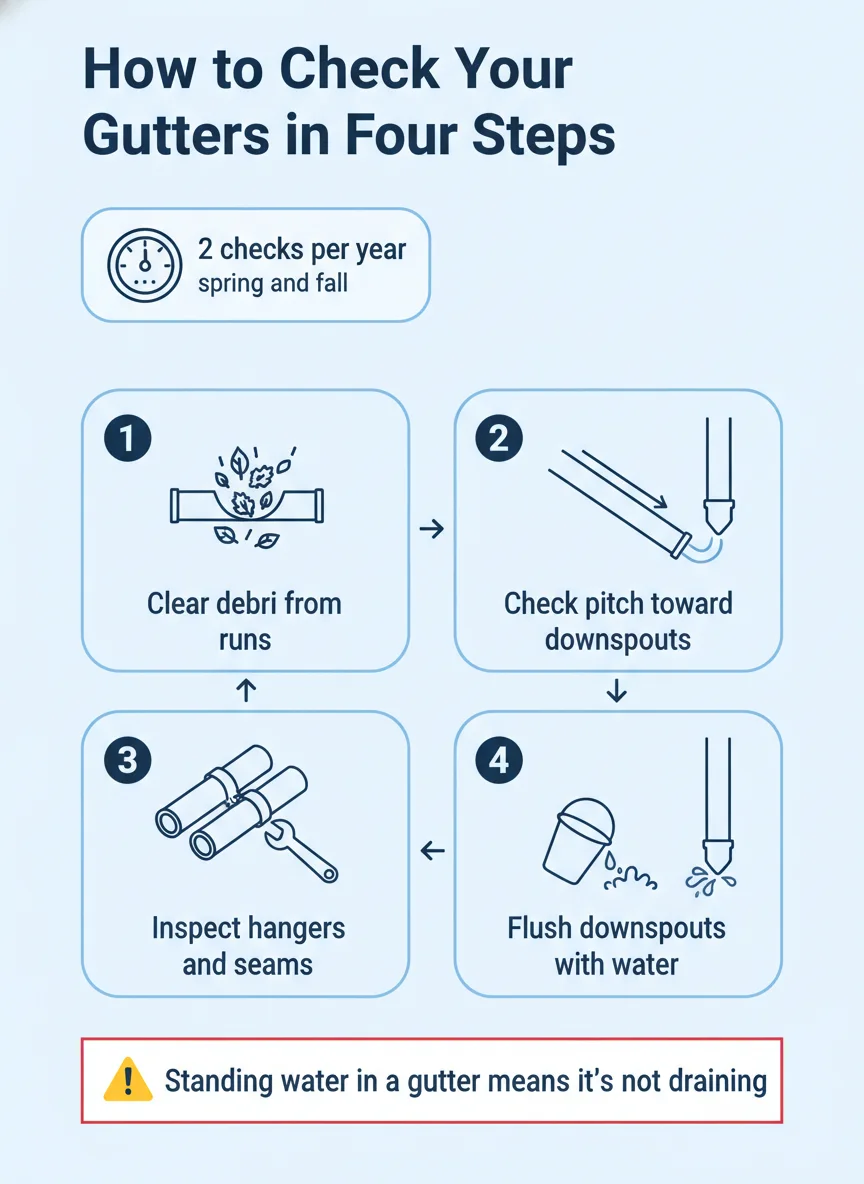
Step-by-Step: The Twice-a-Year Gutter Check
This is the routine worth doing in late spring and again in late fall, before the heavy leaf drop and before the first hard freeze. It takes most homeowners under an hour per pass on a single-story home.
- Clear visible debris: Remove leaves, pods, and grit from the trough by hand or with a scoop, working toward the downspouts.
- Flush each downspout: Run a hose down each downspout opening and confirm water exits freely at the bottom with no backup.
- Check the pitch: Look for standing water or visible sag between hanger points after the flush test drains out.
- Inspect hangers and spikes: Look for hangers pulling loose from the fascia or spikes backing out, both signs of coming failure.
- Check seams and end caps: Look for streaking on siding below a seam, a sign water is leaking out at a joint instead of reaching the downspout.
- Look at the fascia behind it: Check for soft or discolored wood behind the gutter, which points to a leak that's been running for a while.
- Note guard condition if installed: Lift and check that guards are seated properly and not holding a layer of fine debris against the gutter lip.
What You'll Find and What It Means
Water at the Foundation
If you notice damp soil, erosion, or a wet basement corner that lines up with a downspout, the gutter system is likely dumping water right where you don't want it. Downspout extensions that carry water several feet away from the foundation usually solve this, but only once the gutter itself is draining properly upstream.
This is one of the more expensive problems to ignore, since foundation moisture issues cost far more to fix than a gutter repair ever would. It's worth tracing back to the gutter and downspout before assuming it's a grading or drainage problem elsewhere in the yard.
Fascia Rot or Roof Edge Damage
Soft, discolored, or crumbling wood behind the gutter means water has been sitting against the fascia for a while, long enough to start breaking it down. This often traces back to a clog or lost pitch that went unnoticed for a season or two. Left alone, that rot can spread to the roof edge and the first course of roofing material above it.
Catching this early usually means replacing a section of fascia and fixing the gutter issue that caused it. Catching it late can mean more roof repair work than a gutter problem should ever cause.
What You Can Check Yourself vs. When to Call a Pro
Clearing debris, flushing downspouts, and a visual check for sag or streaking are all reasonable for a homeowner comfortable on a ladder, especially on a single-story home. These are the tasks that make up most of the twice-a-year routine and catch the majority of small problems before they grow.
Resetting hangers, re-pitching a full run, replacing damaged sections, or working at a second-story height are where it makes sense to call a licensed pro. Getting pitch exactly right across a long run takes a level and some experience, and ladder work at height carries real risk that isn't worth the savings of doing it solo.
A fascia repair tied to gutter rot, or a gutter system that's pulling away from the house in multiple spots, is also a sign the underlying roof edge may need a closer look, which is a job for roof inspections rather than a weekend project.
Keeping the Routine Going Year After Year
A twice-a-year gutter check isn't glamorous, but it's one of the cheapest ways to protect the roof edge, the fascia, and the foundation of your home. Mark it on the calendar alongside other seasonal home tasks and it stops feeling like a chore and starts feeling like routine maintenance, the same way you'd check smoke detector batteries.
If a check turns up more than a simple cleaning, whether that's a sagging run, a rotted fascia board, or a system that was never pitched right in the first place, Precise Roofing handles gutters across the Denver Metro, including Littleton and the surrounding towns, alongside the roof replacement work that often goes hand in hand with a full gutter overhaul.
Frequently asked questions
How often should gutters be cleaned in Colorado?
Twice a year is the general rule, once in late spring after trees finish dropping seed pods and once in late fall after leaves come down. Homes under heavy tree cover may need a mid-season check too, since clogged gutters back water up under the roof edge.
Do gutter guards mean I never have to clean my gutters again?
No, guards reduce the work but don't eliminate it. Fine grit, pine needles, and seed pods still collect on top of most guard styles, and the guards themselves need an occasional check to make sure they're seated and not holding debris against the gutter lip.
What happens if a gutter is clogged for a long time?
A clogged gutter holds water against the roof edge and fascia board, which can rot wood, loosen shingles at the eave, and in cold months contribute to ice damming. Over time the weight of wet debris can also pull hangers loose and sag the whole run.
Why is my gutter pulling away from the house?
This usually means the hangers or spikes holding it to the fascia have loosened, often from the weight of debris, ice, or age. It's a sign the gutter needs to be reattached and possibly re-pitched before it fails completely in a heavy rain.
Can I install gutter guards myself?
Simple snap-in guard styles are within reach for a comfortable DIYer on a single-story home, but getting the pitch and seams right on a full gutter system, especially with ladders at height, is where most homeowners call a pro. A licensed installer also makes sure the guards don't void any existing gutter warranty.