
Why Attic Air Matters in a Colorado Climate
Denver Metro homes see wide temperature swings, from summer afternoons pushing well past 90 degrees to winter nights dropping well below freezing, sometimes in the same week. That swing puts real stress on an attic space, which sits sandwiched between a hot or cold outdoors and a conditioned living space below. When the attic can't exchange air properly, it traps heat in summer and moisture in winter, and both work against the roof deck and shingles over time.
Most homeowners never think about their attic until something fails, usually a leak, a sagging section of decking, or a shockingly high heating bill. By the time those symptoms show up, the ventilation problem has often been building for years. A roof can look completely normal from the driveway while the attic underneath is quietly shortening its lifespan.
How Intake and Exhaust Ventilation Work Together
A healthy attic ventilation system works like a chimney. Cooler air enters low, typically through soffit vents under the eaves, and warmer air exits high, usually through a ridge vent running along the peak of the roof. That continuous low-to-high flow carries heat and moisture out before they can settle into the wood framing and the underside of the roof deck.
Intake: Soffit Vents and Where Air Enters
Soffit vents are the small perforated panels or strips running along the underside of the roof overhang. They're the quiet workhorse of the system, pulling fresh outside air into the lowest point of the attic. If those vents get painted over, stuffed with insulation, or covered during a past remodel, the whole system loses its air source no matter how good the exhaust side looks.
A simple visual check from the ground with binoculars can often tell you whether soffit vents are open and unobstructed. Inside the attic, baffles (small channels installed between the rafters) should keep insulation from sliding down and sealing off that intake path at the eaves.
Exhaust: Ridge Vents, Box Vents, and Gable Vents
Exhaust vents give the warm, rising air somewhere to go. A ridge vent, a continuous strip along the roof's peak, is the most common modern choice because it vents evenly across the whole roofline rather than from a single point. Older homes often use box vents (individual caps spaced across the roof) or gable vents set into the triangular wall at the end of the attic.
Mixing vent types without planning the airflow can actually work against you, since air may take the shortest path between two exhaust vents instead of pulling fresh air up from the soffits. A consistent, single-system approach, matched to the size of the attic, moves air the way it's designed to.
| Situation | What's Happening | What It Means for the Roof |
|---|---|---|
| Hot attic in summer | Trapped heat with no exhaust path | Shingles age faster, cooling bills rise |
| Frost on nail tips in winter | Warm moist air hitting cold metal and condensing | Decking can rot from the inside out |
| Ice buildup at the eaves | Warm roof surface melting snow that refreezes at the edge | Water can back up under shingles and into the home |
| Even temperature attic to attic | Balanced intake and exhaust airflow | Roof deck and shingles age at a normal rate |
What's Actually at Risk: Decking, Shingles, and Insulation
The roof deck, the wood sheathing that shingles are nailed into, is the part with the most to lose. Decking exposed to repeated moisture from poor ventilation can soften, delaminate, or rot, which is a far more expensive problem than a ventilation fix and often isn't visible until a roof inspection or a repair call turns it up.
Shingles take damage too. Excess attic heat radiates upward and bakes shingles from underneath, on top of the UV exposure they already take from the sun. Insulation suffers in a different way: moisture that settles into fiberglass or cellulose insulation reduces its effectiveness, which means the system that's supposed to protect your living space is working harder for less result.
Step-by-Step: Checking Your Own Attic Ventilation
A basic check takes about 20 minutes with a flashlight and doesn't require climbing on the roof. Do it once in early fall and once in late spring to catch issues before peak heating or cooling season.
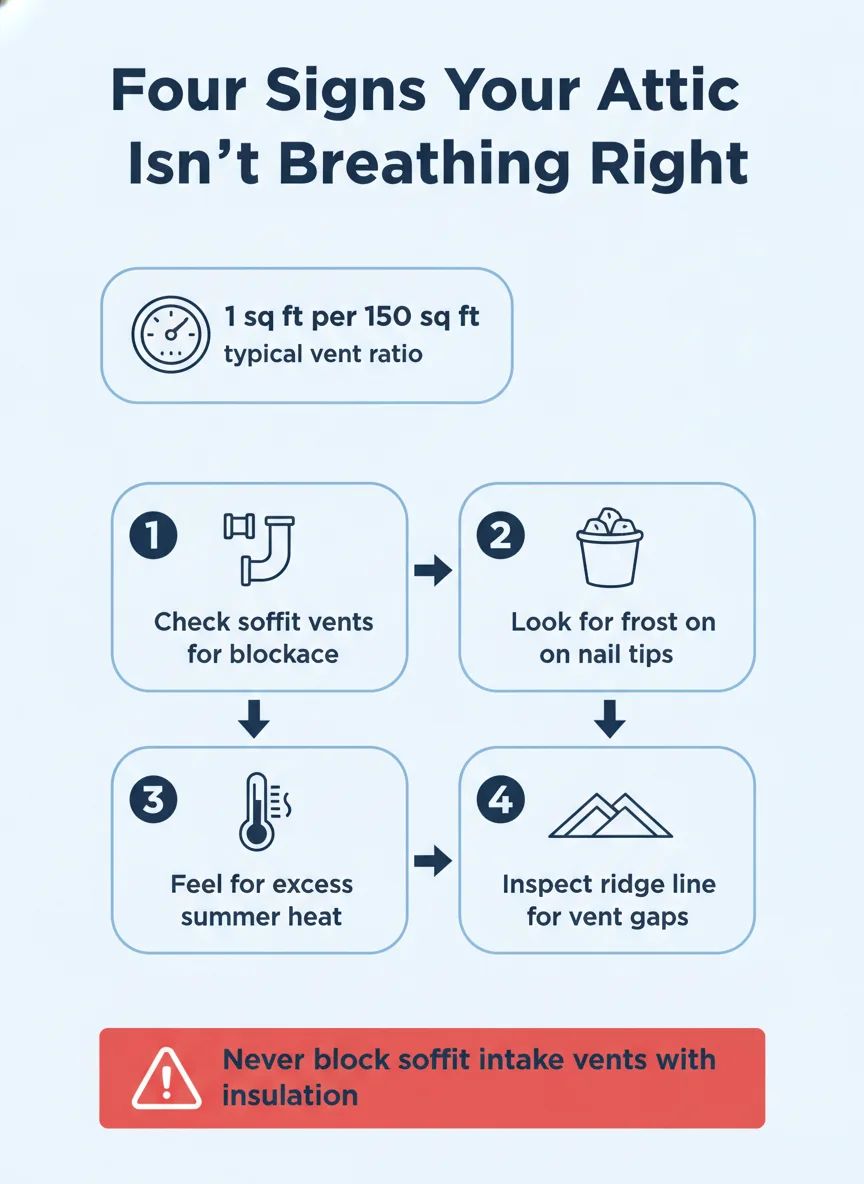
- Check soffit vents outside: Walk the exterior and look for paint, debris, or screens blocking the soffit vent openings under the eaves.
- Enter the attic safely: Use a flashlight and step only on joists or a stable platform, never directly on insulation or drywall.
- Look at the insulation line: Confirm insulation isn't piled up against the eaves and blocking the baffles that protect the soffit intake path.
- Inspect the underside of the decking: Look for dark staining, frost in winter, or a musty smell, all signs of trapped moisture.
- Check for daylight at the ridge: A small gap of light at the ridge vent location is normal; a sealed or painted-over ridge is not.
- Note the attic temperature: On a hot day, an attic that feels dramatically hotter than outside points to inadequate exhaust airflow.
Diagnosing What You Find
Signs of a Moisture Problem
Frost on the underside of the decking or on exposed nail tips in winter is one of the clearest warning signs, since it means warm moist household air is reaching the cold roof surface and condensing instead of venting out. Over a season or two, that moisture cycle can lead to visible mold, soft spots in the decking, or a musty smell when you open the attic hatch.
If you see staining that tracks along the rafters or sheathing rather than pooling in one spot, that pattern usually points to a ventilation issue rather than an active leak, though both deserve a closer look. An experienced eye can usually tell the difference quickly during an inspection.
Signs of a Heat Problem
An attic that feels noticeably hotter than the outdoor air, especially by mid-afternoon, is trapping heat it should be venting out. That heat radiates down into the living space, pushing your cooling system to work harder, and it bakes the underside of the shingles from above the decking at the same time.
Shingles that look prematurely curled, cracked, or faded in patches that don't match sun exposure can be a sign the attic underneath them has been running hot for a long time. It's worth mentioning during a roof repair or replacement conversation, since it changes how long the new roof is likely to last.
What You Can Check Yourself vs. What Needs a Roofer
A homeowner can safely handle the visual checks outlined above: clearing debris from exterior soffit vents, confirming insulation baffles are in place, and watching for frost, staining, or excess heat inside the attic. These checks don't require touching the roof surface and can be done with basic tools and some caution about where you step.
Anything that involves adding or modifying vents on the roof itself, cutting in a new ridge vent, replacing box vents, or correcting a mixed-vent system that's working against itself, should go to a licensed roofer. Getting the vent sizing and placement wrong can create new problems, like pulling conditioned air out of the living space or letting wind-driven rain into the attic.
It's also worth having a roofer confirm whether the decking has already taken damage before any ventilation fix is made, since repairing or replacing rotted decking is a different scope of work than adding airflow. A single visit can usually answer both questions at once.
Keeping the Attic as Protected as the Roof Above It
A roof is only as good as the conditions underneath it. Shingles, flashing, and decking all last longer when the attic behind them is moving air the way it's supposed to, and a lot of premature roof failures trace back to a ventilation problem that went unnoticed for years rather than a defect in the materials themselves.
If a seasonal check turns up frost, heat, or staining that doesn't look right, it's worth getting a second opinion before it becomes a bigger repair. Precise Roofing has served the Denver Metro for more than 20 years and can take a look at both the attic and the roof surface in the same visit.
Frequently asked questions
What does attic ventilation actually do?
Attic ventilation moves outside air in through low vents and pushes warm, moist air out through high vents, keeping the attic close to the outdoor temperature. Without that exchange, heat and moisture build up and work against the roof from underneath year-round.
How do I know if my attic has poor ventilation?
Common signs include frost or moisture on the underside of the decking in winter, a noticeably hot attic in summer, and shingles that curl or bake faster than the rest of the roof. A musty smell or visible mold on rafters is also a strong signal.
Can bad attic ventilation cause ice dams?
Yes, a warm attic melts snow on the upper roof even in freezing weather, and that water refreezes at the cold eaves to form a dam. Balanced intake and exhaust ventilation keeps the roof surface closer to outdoor temperature so melt and refreeze cycles happen less.
Does more insulation mean I need less ventilation?
No, insulation and ventilation solve different problems and you need both. Insulation keeps conditioned air inside the living space, while ventilation manages the attic air above it, and piling insulation over soffit vents actually blocks the airflow you need.
Can a homeowner fix attic ventilation themselves?
Some of it, like clearing insulation away from soffit vents or adding a gable vent, is manageable for a handy homeowner. Cutting in new ridge or roof vents involves working on the roof surface itself and is usually best left to a licensed roofer.