
How Long Should a Roof Last in Colorado's Climate?
The honest answer is that it depends heavily on material, and Colorado's climate is harder on a roof than the national averages most warranty charts are built around. Intense UV at altitude, wide temperature swings between day and night, and regular hail and wind events all chip away at a roof faster than the same material would age in a milder, lower-elevation climate.
That is why two homes with the same shingle, installed the same year, can show very different wear by year fifteen. One might sit on a well-ventilated attic facing north, the other on a west-facing slope that bakes in direct sun every afternoon. Knowing the general lifespan range for your material is the starting point, but the specifics of your home and its weather exposure always shift the number up or down.
Why Lifespan Varies So Much From One Roof to the Next
Two forces do most of the damage over a roof's life: sustained sun exposure and repeated impact or flex from storms. Every material handles these two stresses differently, which is why a lifespan chart is a starting range, not a guarantee, for any individual roof.
UV and Altitude Exposure
At Colorado's elevation, UV intensity is measurably higher than at sea level, and that accelerates the drying and cracking of asphalt oils, the fading of color pigments, and the brittleness of rubber components like pipe boots. Materials that resist UV breakdown well, such as metal and tile, tend to hold their expected lifespan more consistently across different sun exposures than asphalt does.
South and west-facing slopes generally age faster than north-facing ones on the same house, simply from more direct sun hours per day. If you are comparing lifespan estimates to your own roof, the slope's compass direction is worth factoring in alongside the material itself.
Hail and Wind Cycles
Colorado's Front Range sees regular hail activity, and every hit a roof takes adds a small amount of cumulative wear even when no single storm causes an obvious leak. Shingles can bruise, tile can crack, and metal can dent, each reducing the material's ability to perform for its full expected lifespan.
Wind adds a second layer of stress by working at the edges and seams, the places most likely to lift first. A roof that has weathered several hail and wind events, even without a claim filed, has typically used up more of its lifespan than its age alone would suggest. Our storm and hail damage team sees this gap between apparent age and real condition often.
| Roof Material | Typical Lifespan Range | What Shortens It in Colorado |
|---|---|---|
| Three-tab / architectural asphalt shingle | 18-22 years | High-altitude UV, repeated hail impact, poor attic ventilation |
| Standing seam or screw-down metal | 40-60+ years | Fastener wear on screw-down panels, coating fade over decades |
| Concrete or clay tile | 40-60+ years | Cracking from hail or foot traffic, underlayment failing beneath intact tile |
| Slate | 75-100+ years | Individual tile breakage, flashing and fastener failure outlasting the slate itself |
| Flat membrane (TPO, EPDM, modified bitumen) | 15-25 years | Seam separation, ponding water, UV breakdown on unprotected membrane |
What's Actually Wearing Out Under the Surface
A roof is a system, not a single surface, and different parts of that system age at different rates. The visible material, whether shingle, tile, or membrane, is what most homeowners judge age by, but the roof deck, underlayment, and flashing underneath often determine how much longer the visible layer can actually perform.
Underlayment is the water-resistant barrier beneath the surface material, and it has its own service life that does not always match the shingle or tile above it. Flashing around chimneys, skylights, and vents is typically metal and can outlast or underperform the main roofing material depending on how it was installed and sealed originally.
- Roof deck: the wood base layer; moisture or rot here shortens everything installed above it
- Underlayment: the hidden water barrier; brittle or torn underlayment lets water through even with intact shingles above
- Flashing: metal seals at chimneys, skylights, and valleys; a common failure point regardless of the main material's age
Step-by-Step: How to Estimate Where Your Roof Stands
You don't need to climb a ladder to get a reasonable read on your roof's place in its lifespan. These steps combine what you can check from the ground and the attic with what a professional inspection adds.
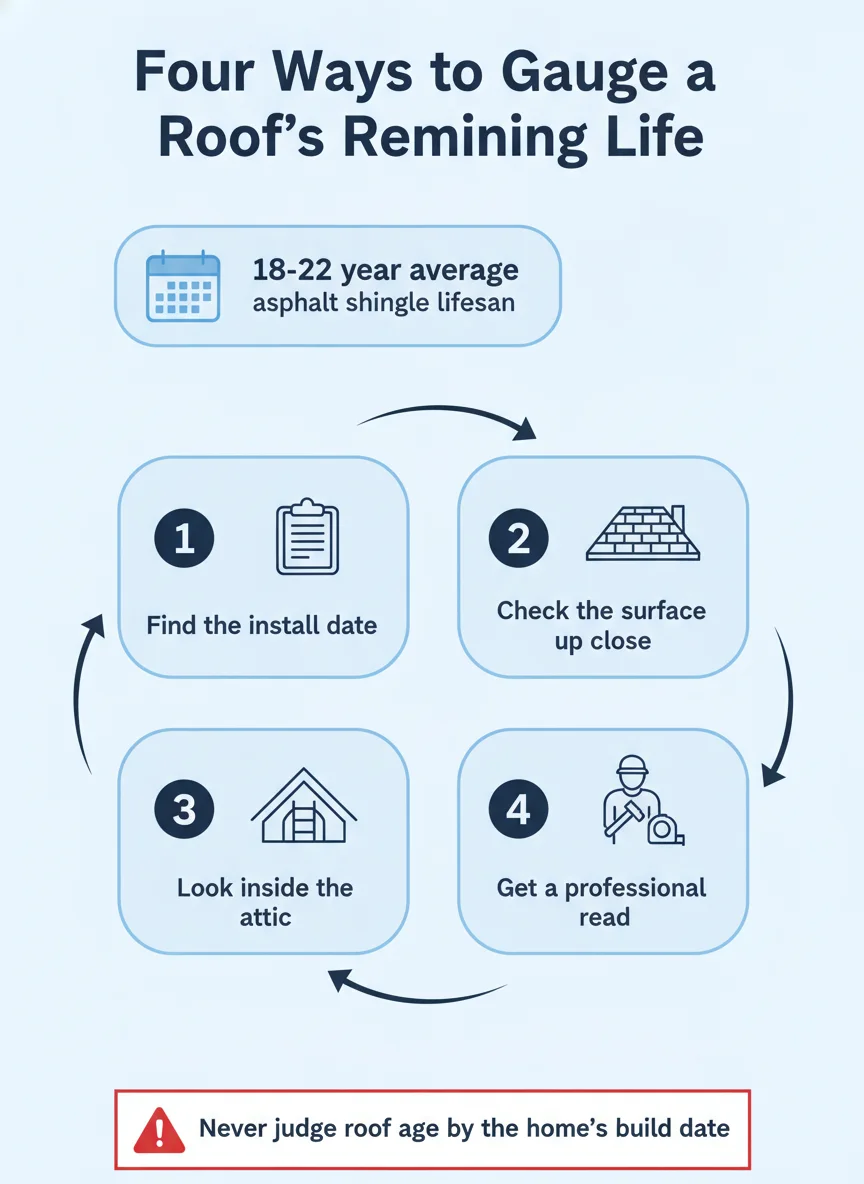
- Find the install date: Check closing documents, a prior invoice, or a permit record for the actual year the current roof went on, not the year the home was built.
- Match the material to the chart: Identify whether you have asphalt, metal, tile, slate, or a flat membrane, and compare the install year to that material's typical range.
- Check the surface up close: Look for curling, cracking, granule loss, or faded color from the ground with binoculars, all signs a roof is further along than its age alone suggests.
- Look inside the attic: Daylight through the roof deck, damp insulation, or a musty smell point to underlayment or flashing issues that shorten real-world lifespan.
- Review storm history: Recall any significant hail or wind events since install, since cumulative impact wear often outpaces calendar age.
- Get a professional read: A roof inspection gives a direct assessment of remaining life rather than an estimate based on age alone.
Diagnosing the Signs a Roof Is Near the End
A roof nearing the end of its lifespan usually gives warning signs well before a leak actually appears. Catching those signs early is what turns a planned replacement into a choice instead of an emergency.
Signs on the Surface
Curling or cupped shingle edges, bald patches where granules have worn away, and streaks of algae or moss are all visual cues that a shingle roof is aging past its prime. On tile or metal, look for cracked pieces, rust streaks at fasteners, or panels that have visibly lifted at a seam.
Color fade alone is mostly cosmetic, but combined with brittleness, meaning shingles that crack rather than flex when lightly pressed, it usually signals the material has lost much of its flexibility and water resistance.
Signs Inside the Attic
The attic often reveals problems before the exterior does. Daylight visible through the roof deck, dark staining on rafters, or insulation that feels damp to the touch are all signs that water is getting past the roofing system even if no stain has reached the ceiling yet.
A musty smell or visible mold on the underside of the deck points to longer-term moisture, often tied to ventilation issues that accelerate wear on the roofing material above. These attic signs are worth checking at least once a year, and definitely after any major storm.
DIY vs. Calling a Pro to Judge Roof Age
Checking the attic for daylight, staining, or damp insulation is something most homeowners can safely do themselves with a flashlight, as can scanning the roof's surface from the ground with binoculars for obvious curling or missing pieces. These checks are a reasonable first pass and cost nothing but a few minutes.
What a homeowner usually can't assess safely or accurately is the condition of the underlayment, the flashing seals, and the deck itself, since those require getting on the roof and often probing or lifting material to check for hidden rot or granule loss patterns. Walking a roof without the right footwear or experience also risks both a fall and further damage to an already aging surface.
A licensed roofer brings the training to read wear patterns accurately, the safety equipment to check a roof thoroughly, and the experience to tell a cosmetic issue apart from one that's actually shortening the roof's remaining life. For anything beyond a ground-level and attic check, bringing in a professional is the safer and more reliable path.
Getting a Clear Read on Your Roof's Age
A lifespan chart gives you a starting range, but every roof in the Denver Metro has its own story shaped by slope direction, storm history, and how well it has been maintained. The only way to know exactly where your roof sits in that range is to have it checked by someone who can see past the surface.
If your roof is approaching the upper end of its material's typical lifespan, or you've noticed any of the warning signs above, it's worth getting an answer before a small issue becomes a bigger one. Homeowners from Denver to the surrounding towns can get that answer, and if you want to compare how asphalt shingles vs metal roofing hold up long-term before a replacement decision, that comparison is worth a read too. Precise Roofing has been checking and replacing roofs across the region for over 20 years.
Frequently asked questions
Does the age of my house tell me the age of my roof?
No, not reliably. A house built decades ago may have had the roof replaced once or several times since, so the home's build date and the roof's install date are often completely different numbers, and only a record of the last replacement or a professional inspection tells you the real age.
What roofing material lasts the longest in Colorado?
Among common materials, metal, tile, and slate generally outlast asphalt shingles by a wide margin, often reaching several decades or more where shingles reach roughly two decades. Altitude, hail frequency, and how well the attic is ventilated still affect every material's real-world lifespan.
Does altitude actually shorten roof life?
Yes, higher elevation means more intense UV exposure, which breaks down asphalt oils and fades color faster than at sea level. That is one reason roofs in Colorado's mountain and foothill communities can show wear sooner than the same shingle would in a lower, cloudier climate.
Can hail shorten a roof's expected lifespan even without visible leaks?
Yes, hail impacts can bruise a shingle's mat or crack tile without creating a leak right away, but that damage weakens the material's ability to shed water and resist UV over time. A roof that looks fine after a storm can still be aging faster than its rated lifespan suggests.
How often should I have my roof's age and condition checked?
A yearly look, plus a check after any significant hail or windstorm, is a reasonable baseline for most materials. A [roof inspection](/services/roof-inspections) gives you a clear read on where a roof sits in its lifespan rather than guessing from the ground.