
A Small Repair in Colorado Isn't Always a Small Job
Homeowners across the Denver Metro deal with the same temptation every spring and fall: a shingle blew off, a vent boot is cracked, or a small stain showed up on the ceiling, and it feels like a weekend fix. The question of whether to call a licensed roofer or a general handyman comes up constantly, and the honest answer is that it depends on exactly what's wrong and where it is on the roof.
Colorado's weather swings hard between hail, wind, heavy snow load, and intense UV, and all of that stress concentrates at the same vulnerable points on a roof: flashing, valleys, and penetrations like vents and chimneys. A repair that looks cosmetic on the surface can be sitting right on top of one of those stress points, which changes the calculation on who should do the work.
Why This Decision Matters More Than It Looks
The risk with a small roof repair isn't usually the labor cost, it's what happens when the repair doesn't actually solve the problem. Water doesn't respect a patch job. It finds the next weak point, and by the time it shows up again as a stain or a soft spot, it may have already damaged decking or insulation you can't see from the ground.
What a licensed roofer brings to a small job
A licensed roofer has handled hundreds of similar repairs and knows how to trace a leak back to its actual source instead of patching the symptom. They also carry insurance that protects your home if something goes wrong on the job, and they can match materials correctly so the repair blends with the rest of the roof instead of standing out as an obvious patch.
Just as important, most licensed roofers put a repair under a written workmanship warranty, which means if the same spot leaks again, it's covered. That's a layer of protection a general handyman typically can't offer, since roofing isn't their core trade.
Where a handyman is a reasonable choice
Not every roof issue needs a roofing specialist. Cosmetic fixes, like resetting a loose piece of trim near the roofline or caulking a small gap that isn't actively leaking, fall well within a general handyman's skill set and usually cost less to schedule.
A handyman also makes sense when the work is clearly unrelated to the roofing system itself, such as fixing a fascia board that's cosmetically damaged but not letting in water. The line gets blurry fast, though, the moment the job involves shingles, flashing, or anything that requires getting up on a steep pitch.
| Situation | Licensed Roofer | Handyman |
|---|---|---|
| Matching existing shingle color and profile | Trained to source and match materials correctly | May use whatever is on hand, creating a visible patch |
| Diagnosing where a leak originates | Trained to trace water through flashing and underlayment | Often treats the visible symptom, not the source |
| Working near flashing, valleys, or steep pitch | Equipped and insured for roof-specific work | Higher risk without roofing-specific training |
| Written warranty on the repair | Common with a licensed roofing company | Rare, varies by individual |
What's Actually Involved in a Small Roof Repair
Even a repair that sounds simple, like a missing shingle or a cracked vent boot, touches several layers of the roofing system. Underneath the visible shingle is underlayment that provides the real waterproofing barrier, and beneath that is the decking the whole system is fastened to. A repair that only replaces the top layer without checking the layers underneath can leave hidden damage in place.
Flashing, the metal strips sealing joints around chimneys, skylights, and roof valleys, is one of the most common failure points on any roof and one of the trickiest to repair correctly. It has to be layered and sealed in a specific order to shed water properly, which is a detail that matters more than it sounds like from the ground.
Step-by-Step: How to Decide Who to Call
Before you pick up the phone, walk through a short checklist. It won't replace a professional opinion, but it will tell you which direction to lean before you spend money on a diagnosis.
- Locate the damage: Find exactly where the issue is on the roof, not just where the stain shows up inside, since water can travel before it drips.
- Check proximity to flashing: If the damage is within a few feet of a chimney, skylight, vent, or valley, lean toward a licensed roofer.
- Assess the pitch and access: A steep or multi-story roof raises both the risk and the skill required, which favors a roofing specialist.
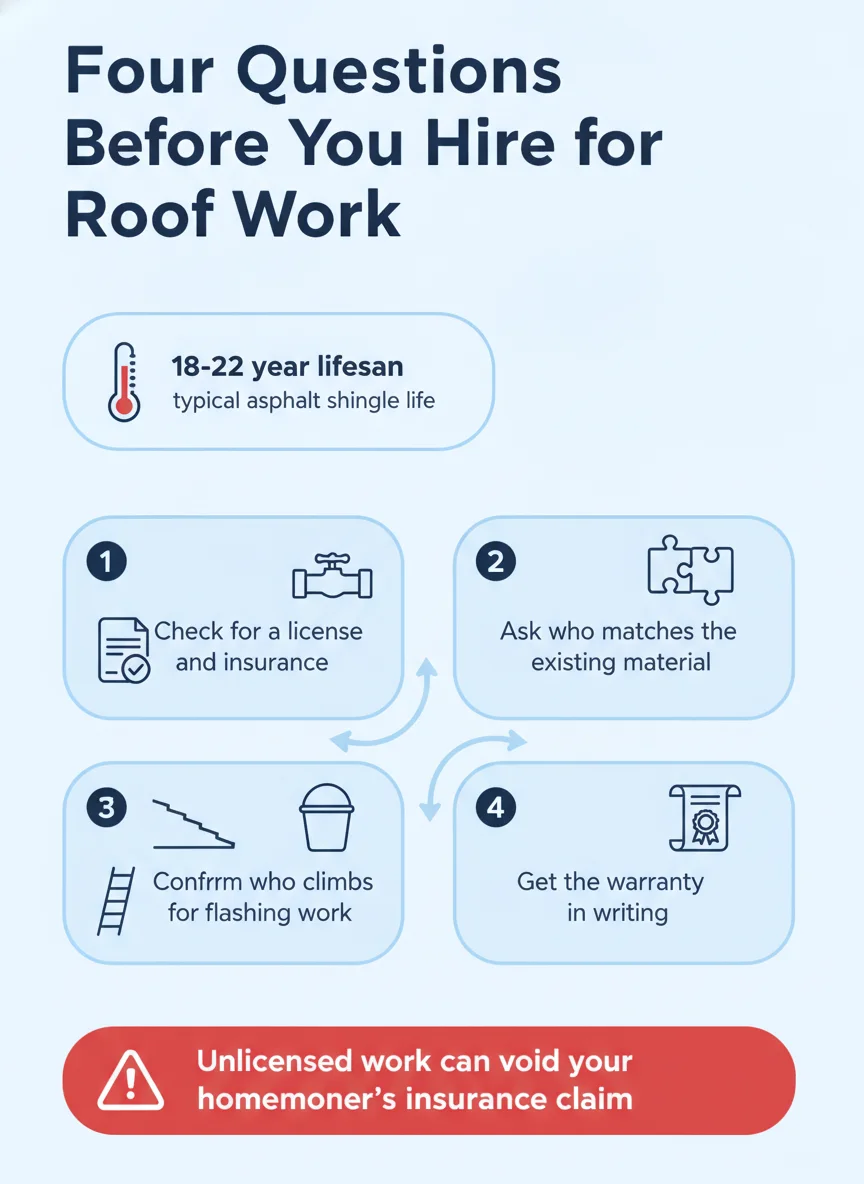
- Ask about material matching: If the repair needs to blend with existing shingles or a metal panel, confirm the contractor can source a matching product.
- Confirm licensing and insurance: Ask directly whether the person doing the work is licensed and insured for roofing, not general contracting.
- Get the warranty in writing: A verbal promise isn't the same as a written workmanship warranty, so ask for documentation before work starts.
What You'll Usually Find Once the Roof Is Opened Up
When the damage is isolated
Sometimes a small repair really is small. A single cracked shingle from a wind gust, caught early, often comes out clean with no sign of water intrusion into the decking below. In these cases, the fix is quick and the cost stays low no matter who does the work, as long as the replacement shingle matches and seals correctly.
The key word is early. A missing or cracked shingle that's been exposed for one season of Colorado sun and snow is a much smaller problem than the same shingle left through two or three seasons, which is why a free roof inspection after you notice an issue is worth scheduling even if the damage looks minor.
When the damage has already spread
Other times, pulling back the shingle reveals darkened, soft, or delaminating decking underneath, a sign that water has been getting in for a while before anyone noticed. At that point, a surface patch won't hold, and the repair needs to include replacing the affected decking and underlayment, not just the visible shingle.
This is exactly the scenario where hiring the wrong person for the job costs more in the long run. A handyman without roofing training may not catch the compromised decking at all, patch over it, and leave the real problem to keep spreading out of sight.
DIY, Handyman, or Licensed Roofer: Who Does What
A confident homeowner can safely handle a few things: clearing debris from a low-slope roof, checking a vent boot visually from a ladder, or resealing caulk around a satellite mount that isn't actively leaking. These tasks don't require getting onto a steep pitch or disturbing the roofing material itself, which keeps the risk low.
A handyman is a reasonable step up for cosmetic trim work, gutter cleaning, or anything adjacent to the roof but not part of its waterproofing system. The moment a job involves removing or replacing shingles, working around flashing, or diagnosing where water is actually entering, it moves into licensed roofer territory.
The reason comes down to training and liability. A licensed roofer carries insurance that protects you if a fall or a mistake damages your home, and they're trained to recognize the difference between a cosmetic issue and a structural one. A general handyman, however skilled, usually hasn't had that roofing-specific training, and a mistake on a roof is far more expensive to fix than most other home repairs.
Making the Right Call Before You Hire Anyone
The safest approach for most homeowners is to start with a professional opinion rather than guessing from the ground. A quick roof repair assessment will tell you whether you're looking at an isolated fix or something that's already spread further than it appears, and it costs you nothing to find out for sure.
If you're weighing whether what you're seeing is still repairable or has crossed into replacement territory, it's worth reading When a Roof Is Past Repair: The Signs to Watch For before you make a decision either way. Precise Roofing has handled both the small fixes and the bigger ones for homeowners throughout the Denver Metro for more than 20 years.
Frequently asked questions
Can a handyman fix a roof leak?
A handyman can sometimes patch a surface-level leak, but finding the actual source of a leak often means tracing water back through flashing, valleys, or underlayment that a general handyman isn't trained to diagnose. If the fix doesn't address the source, the leak usually comes back in the next storm.
Is it cheaper to hire a handyman instead of a roofer?
A handyman's hourly rate is often lower, but cost isn't just the invoice. A repair that fails or voids a warranty ends up costing more once you pay a licensed roofer to redo it correctly.
Do I need a licensed roofer for a single missing shingle?
A single missing shingle can sometimes be a quick fix for a handy homeowner or a handyman, especially on a low-slope, easy-access roof. Anywhere near a valley, chimney, or steep pitch, a licensed roofer is the safer call.
Will my insurance cover repairs done by a handyman?
That depends entirely on your policy, and many insurers require documentation from a licensed contractor for storm-related claims. Check with your insurance company before you hire anyone if you plan to file a claim.
How do I know if a roof repair is actually a small job?
A roof repair stays small when it's isolated to one shingle, one vent boot, or one small area with no sign of water tracking elsewhere. If you see staining on more than one ceiling, soft spots in the decking, or damage near a flashing point, it's bigger than it looks.