
Why Do Shingle Brands Even Matter in Colorado's Climate?
Shingle brands matter because Colorado's roofs deal with intense UV exposure, big temperature swings between day and night, and the chance of hail in a given season. A shingle that holds up fine in a mild coastal climate can age faster here if it wasn't built with a decent wind rating and granule bond. The brand name on the bag is less important than the spec sheet underneath it, but most homeowners never see that spec sheet until they're already comparing quotes.
Across the Denver Metro, the major national manufacturers (GAF, Owens Corning, CertainTeed, Atlas, Malarkey, and Tamko) all make products aimed at this kind of climate. None of them make a bad shingle at the architectural tier, but they differ on wind rating thresholds, how the warranty is structured, and what's included if a contractor installs it incorrectly. Knowing the differences helps you ask better questions when you're comparing options for a roof replacement.
What Actually Separates One Shingle Brand From Another
Every major brand sells roughly the same three tiers: three-tab, architectural (also called dimensional or laminate), and a designer or luxury tier meant to mimic slate or shake. Within those tiers, the real differences show up in four places: wind rating, impact rating, warranty structure, and algae resistance. A shingle one step up in price from a competitor's isn't automatically better, it just may test higher on one or two of those specs.
Wind and Impact Ratings
Wind ratings tell you the speed a shingle was tested to withstand when installed per the manufacturer's instructions, typically expressed in miles per hour. Architectural shingles generally test higher than basic three-tab shingles because of their heavier weight and reinforced nailing zone. This rating only holds if the installer follows the exact nailing pattern and starter strip method the manufacturer specifies, which is one reason installation quality matters as much as the shingle brand.
Impact ratings, most commonly the Class 4 designation, measure how a shingle holds up against repeated simulated impacts without cracking the mat underneath the granules. Several manufacturers offer a Class 4 option within their architectural or designer lines, usually at a price premium over the standard version. In a region that sees hail, a Class 4 shingle is worth asking about, though it's one factor among several, not a guarantee against damage.
Warranty Structure
Every manufacturer backs its shingles with a limited warranty against material defects, but the length and depth of that coverage varies by product line. Entry-level shingles often carry shorter manufacturer warranties than architectural or designer lines from the same brand. Some manufacturers also offer enhanced warranty tiers to contractors who've met specific certification requirements, which can extend coverage to include labor in certain failure scenarios.
It's worth separating the manufacturer's warranty, which covers the shingle itself, from a contractor's workmanship warranty, which covers installation errors. A long manufacturer warranty doesn't help if the roof fails because of a flashing mistake or poor nailing, since that falls under workmanship, not the shingle. Ask any contractor you're comparing what their own written workmanship warranty covers separately from the shingle's paperwork.
| Shingle Tier | Typical Lifespan | Where It Fits |
|---|---|---|
| Three-tab | Shorter end of the range | Budget-conscious projects, rental properties |
| Architectural (dimensional) | Mid-to-long range | Most Colorado homes, good balance of cost and durability |
| Designer/luxury | Longest-rated tier | Homes where appearance and maximum durability both matter |
The Shingle Itself: What's Under the Granules
Every asphalt shingle, regardless of brand, is built the same basic way: a fiberglass mat soaked in asphalt, topped with mineral granules that provide color, UV protection, and the fire rating. The quality difference between brands usually comes down to how much asphalt saturates the mat, how uniformly the granules are applied, and how strong the adhesive sealant strip is between tabs. None of that is visible by looking at the color sample in the supply house, which is why spec sheets matter more than showroom displays.
The granules also carry the algae-resistance treatment, usually a copper or zinc compound, that slows the dark streaking many Colorado roofs eventually show on the north-facing slope. Not every product line includes this treatment by default, and it tends to wear off gradually over the shingle's life regardless of brand. If streaking resistance matters to you, it's a line item worth confirming rather than assuming it's standard.
Step-by-step: How to Compare Shingle Brands Before You Buy
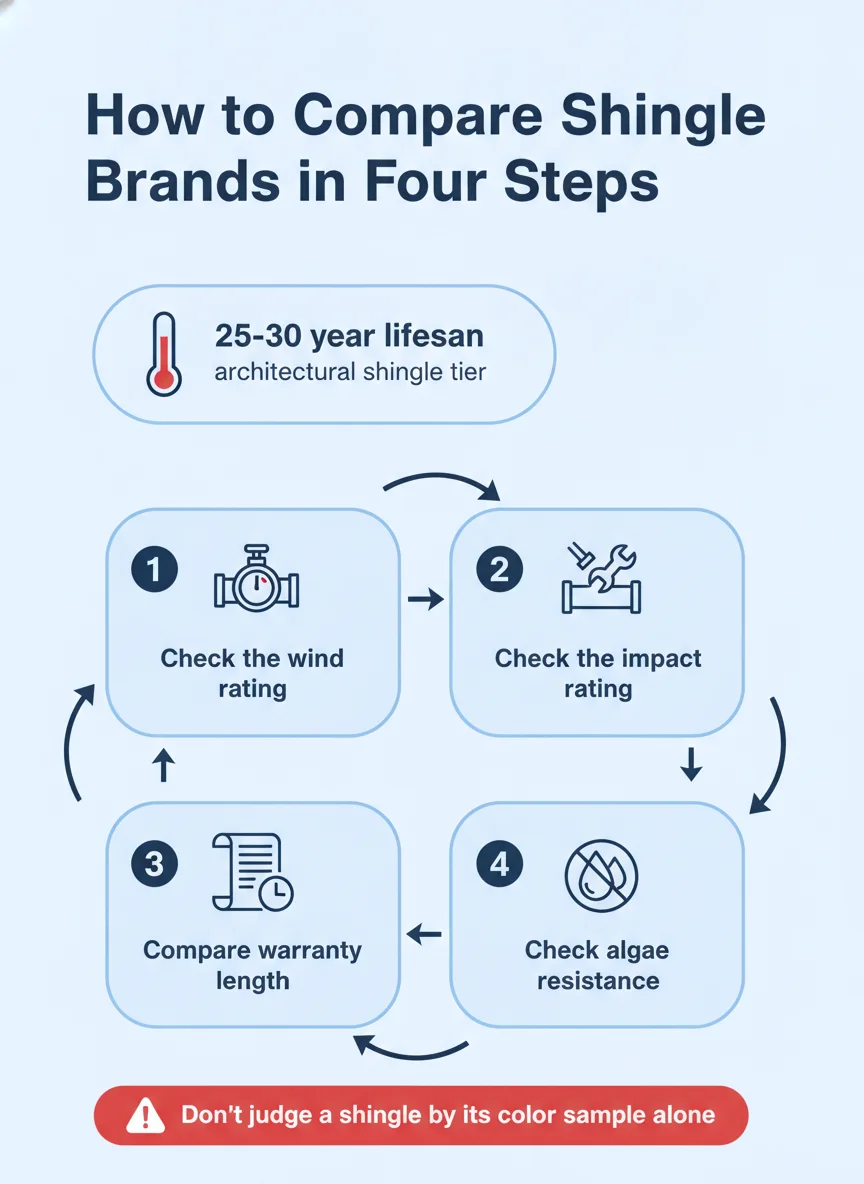
Comparing brands properly takes about fifteen minutes with a spec sheet in hand, and it saves you from picking based on marketing language alone. Here's the order that actually tells you something useful.
- Pull the spec sheet: Ask your contractor for the actual manufacturer spec sheet for the exact product line, not just the brand name.
- Check the wind rating: Compare the tested wind speed and confirm it matches the installation method your contractor plans to use.
- Check the impact class: Look for a Class 4 rating if hail resistance is a priority for your property.
- Read the warranty terms: Note whether the warranty covers materials only or extends to labor under certain certified-installer conditions.
- Ask about algae resistance: Confirm whether the specific product line includes an algae-resistant granule treatment.
- Compare availability: Some product lines and colors have longer lead times than others, which can affect your project schedule.
What Should You Look For on a Shingle Spec Sheet?
A shingle spec sheet should directly show you the wind rating, impact classification if applicable, algae-resistance warranty length, and the product's weight per square, which is a rough proxy for durability. These numbers are what actually separate one brand or product line from another, far more than the glossy photo on the front of the bundle wrapper.
Algae Resistance Ratings
Algae resistance is usually expressed as its own separate warranty term, often shorter than the main material warranty, because the granule treatment wears thin faster than the asphalt mat itself degrades. Homes in shaded areas or with north-facing slopes see streaking sooner regardless of brand, since moisture lingers longer on those sections of roof.
If a previous roof developed heavy streaking, it's worth asking specifically about the algae-resistance warranty length on any product you're considering, since this figure varies more between product lines than most other specs on the sheet.
Availability and Regional Fit
Not every shingle line is stocked locally in every color at every supply house, and some designer-tier products run on longer lead times during busy seasons. This matters most if your project is time-sensitive, like after storm damage, since waiting weeks on a specific color can delay a storm damage repair.
A contractor familiar with the local supply chain can usually tell you up front which product lines are readily available and which ones require a special order, which is worth asking before you fall in love with a color sample.
DIY Research vs Calling a Professional Roofer
Comparing spec sheets, reading warranty language, and narrowing down a shortlist of brands is something any homeowner can do on their own time with a cup of coffee and a search engine. This part of the process doesn't require a ladder or a license, just patience and a willingness to ask contractors for the actual documentation instead of taking a sales pitch at face value.
Where a professional matters is confirming which products are actually suited to your roof's pitch, your attic ventilation setup, and your home's exposure to sun and wind. A shingle that's technically excellent can still underperform if it's mismatched to the roof it's installed on, which isn't something you can judge from a spec sheet alone.
A licensed roofer also knows which manufacturers extend enhanced warranty coverage to certified installers in your area, which can change the real-world value of one brand over another for your specific project. That's information worth getting before you commit to a product line, not after.
Picking the Right Shingle for a Colorado Roof
There's no single best shingle brand across the board, just the product line that matches your budget, your roof's exposure, and how long you plan to stay in the home. Checking wind rating, impact class, warranty structure, and algae resistance across two or three brands tells you more than any color sample or showroom display ever will.
If you're weighing options for your home in Denver or anywhere else in the metro, it helps to also understand how three-tab, architectural, and designer shingle grades differ, since tier matters as much as brand. Precise Roofing can walk you through spec sheets for the lines available in your area so the comparison is based on facts, not marketing copy.
Frequently asked questions
Are more expensive shingle brands actually better?
Not always, price mostly tracks the shingle's tier (three-tab, architectural, or designer), not which company made it. Two architectural shingles from two different manufacturers often perform similarly because they're built to the same general industry standards.
What's the difference between a three-tab and an architectural shingle?
Three-tab shingles are flat, single-layer, and the lightest-duty option on the market, while architectural shingles are laminated with two or more layers for a thicker, more dimensional look. Architectural shingles also tend to carry longer warranty terms and higher wind ratings.
Does a higher wind rating mean a shingle won't blow off?
A higher wind rating means the shingle passed testing at that wind speed when installed to the manufacturer's specifications, not that it's immune to every storm. Installation quality, including nailing pattern and sealant strip bonding, affects wind performance as much as the shingle itself.
What does a Class 4 impact rating mean?
A Class 4 impact rating means the shingle passed a standardized test simulating repeated impacts without cracking, which is the toughest rating in that test. It's a relevant spec in hail-prone regions, though it doesn't guarantee zero damage in every storm.
Do all shingle brands offer the same warranty?
No, warranty length and what's covered vary by manufacturer and by product line within that manufacturer. Some warranties cover material defects only, while others add coverage for workmanship when installed by a certified contractor, so it's worth reading what's actually included rather than just the number of years printed on the package.