
Why Nail Length Is a Bigger Deal Than It Sounds
In the Denver Metro and across Colorado, wind is one of the main forces a roof has to withstand year after year. A roof can have premium shingles on it and still fail early if the fasteners holding it down weren't the right length or weren't driven correctly. Nail length isn't a detail homeowners usually think about when comparing quotes, but it's one of the first things a trained crew checks before the first bundle goes down.
Every roof has a different starting point. A tear-off down to bare decking calls for a different nail than a roof going over an existing layer, and thicker decking takes a different nail than thinner sheathing. Getting this wrong doesn't usually show up on day one. It shows up two or three years later as shingles that lift in wind, nail heads that back out, or small leaks that seem to come from nowhere.
What Determines the Right Nail for a Given Roof
The goal of any roofing nail is simple: it needs to go through the shingle, through any underlayment, and far enough into solid wood decking to hold against uplift. Everything about nail selection flows from that goal.
Decking thickness and layers
Decking thickness varies by the age and construction of the home, and so does the number of shingle layers already on the roof if it's a roof-over rather than a full tear-off. A nail sized for a single layer over thick decking won't reach far enough if it's used over two layers, which is one reason most roofers in Colorado recommend a full tear-off rather than stacking a new layer on top of an old one.
Thinner decking, common in some older homes, can also mean a nail that's too long pokes through the underside of the roof deck into the attic space. That's a cosmetic issue more than a structural one, but it's a sign the crew didn't match the fastener to the roof, which raises questions about what else they rushed.
Wind exposure and local code expectations
Homes on exposed hillsides, open plains, or upper floors of taller buildings see more wind load than a single-story home tucked between other houses. Building codes in wind-prone regions often call for more nails per shingle rather than longer nails, since the nailing pattern does more for wind resistance than nail length alone once the nail is properly seated in the decking.
A good contractor adjusts both the nail and the pattern to the site, not just to a generic spec sheet. If a homeowner asks what nailing pattern a crew plans to use before work starts, a straight answer is a decent sign of how much they actually think about the install rather than just getting shingles on the roof as fast as possible.
| Factor | Shorter / lighter nailing | Longer / heavier nailing |
|---|---|---|
| Decking | Works on thick decking, single layer | Needed over thicker builds or added layers |
| Wind exposure | Fine on sheltered, low-wind sites | Required on exposed or high-wind sites |
| Nail count per shingle | Four nails, standard conditions | Six nails, higher-wind areas |
| Risk if undersized | Shingles lift and blow off early | N/A, this column addresses overbuilding |
The Nailing Line: The Part of the Shingle Most People Never Notice
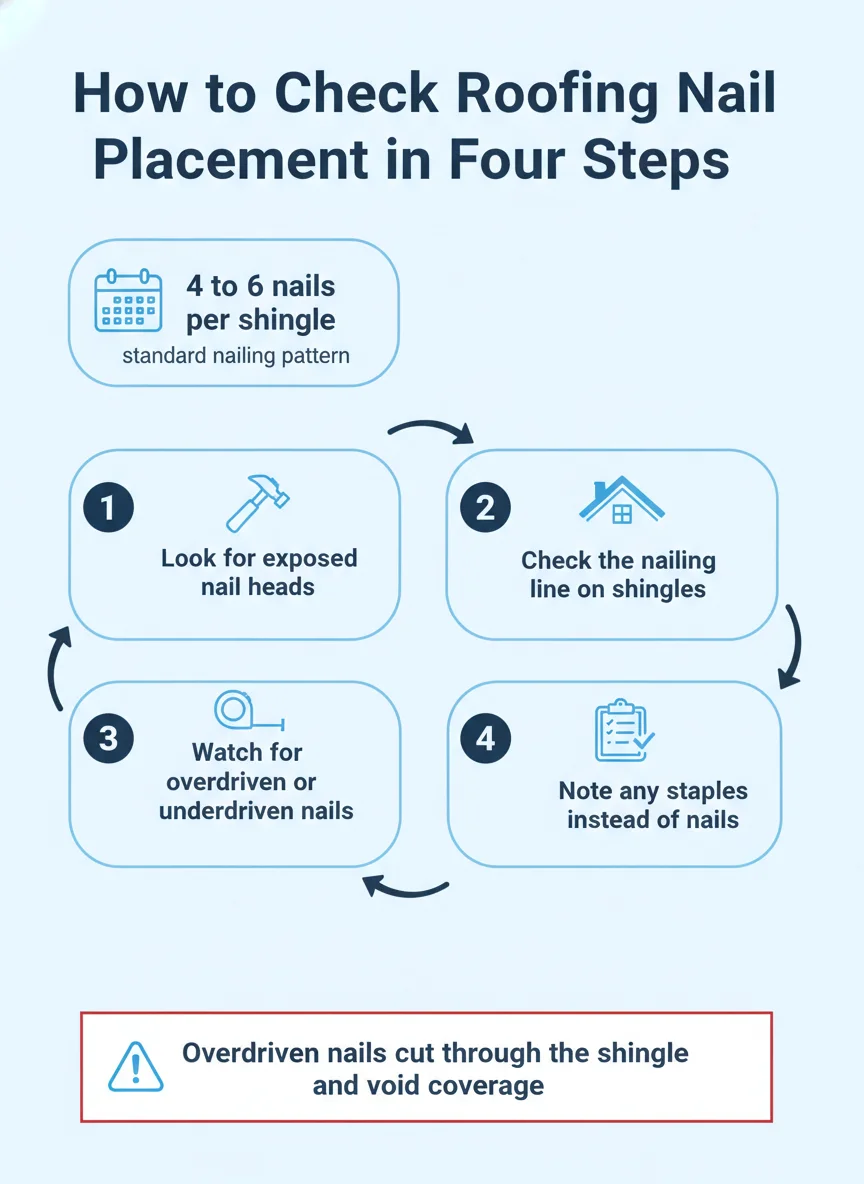
Every asphalt shingle is manufactured with a marked nailing line, a strip printed or embossed on the shingle that shows exactly where the fasteners belong. Nails placed above that line miss the reinforced zone of the shingle below and can tear loose in wind. Nails placed below the line often get exposed when the next course of shingles is applied, which means every one of those exposed heads is a potential water entry point.
This is one of the reasons a quick glance from the ground doesn't tell you much about install quality. The shingles can look perfectly aligned while the nails underneath are in the wrong spot entirely. It usually takes someone walking the roof, or at minimum a detailed close-up inspection, to catch nailing-line mistakes before they cause a problem.
Step-by-step: How a Proper Nailing Pattern Gets Installed
A crew that nails a roof correctly works through the same sequence on every shingle, every course, every time. It's repetitive work, but the repetition is exactly what keeps the pattern consistent across the whole roof.
- Confirm decking and layers: Before fastening starts, the crew checks what's underneath, bare decking, old layers, or a roof-over, so the right nail length gets picked for that specific roof.
- Set the nail gun or hand-nail depth: Pressure or depth gets adjusted so nails sit flush with the shingle surface rather than overdriven through it or left proud above it.
- Align to the nailing line: Each nail goes into the marked strip on the shingle, not above or below it, so the fastener actually engages the reinforced part of the material.
- Place the full nail count: Four nails in standard conditions, six in higher-wind areas, spaced evenly across the shingle width rather than clustered in the middle.
- Check as the courses go up: A crew lead spot-checks nailing on earlier courses while later courses go in, catching problems before the whole slope is covered.
- Walk the finished roof: Once shingles are down, a final check looks for any heads sitting proud, any overdriven nails, and any spots that got missed.
What Bad Nailing Looks Like Once the Roof Is Done
Overdriven nails
An overdriven nail gets punched too far into the shingle, cutting through the mat instead of sitting flush against it. The shingle still looks fine from a distance, but that cut is a direct path for water once wind-driven rain gets under the tab above it. Overdriving is more common with nail guns set at too high a pressure, which is why pressure gets checked and adjusted through the day as conditions change.
Finding overdriven nails usually requires lifting a tab or two during a close inspection rather than looking from the ground or even from a ladder. It's one of the quieter problems a roof can have, since it doesn't show up as a visible defect until a leak develops.
Underdriven or exposed nails
An underdriven nail sits proud of the shingle surface instead of flush, which can wear through the shingle above it over time and create a raised bump that collects less granule coverage and wears faster in UV exposure. Exposed nail heads, meanwhile, sit in the open where they weren't meant to be covered at all, which is a near-guaranteed path for water.
Both problems are things a roof inspection will typically catch, since they're visible once someone is actually walking the slopes rather than viewing the roof from the yard.
What a Homeowner Can Check vs What Needs a Licensed Roofer
A homeowner can do a reasonable visual scan from the ground with binoculars, looking for shingles that appear lifted, curled, or missing entirely, since those are often downstream signs of a nailing problem. Checking gutters for granule buildup after a windstorm is another thing anyone can do, since heavy granule loss can point to shingle wear that nailing problems can accelerate.
What a homeowner generally can't safely check is the nailing itself. That requires walking the roof surface, which carries real fall risk on a pitched roof, and it requires knowing what a correct nailing line and pattern actually look like versus one that's been rushed. This is squarely a job for a licensed roofer with the right harness and experience reading a roof surface.
If nailing problems are found, the fix ranges from a targeted roof repair on the affected sections to a broader look at whether the whole roof was installed with the same shortcuts. A reputable contractor will tell you which situation you're in rather than pushing straight to the more expensive option.
Getting Nailing Right the First Time
Nail length and pattern aren't glamorous topics, but they're a big part of what separates a roof that holds up through a decade of Colorado wind from one that starts shedding shingles in year three. It's worth asking any contractor bidding on your home what nail type and pattern they plan to use, the same way you'd ask about the shingle brand itself. For related background on what else affects how long a roof lasts, see our post on what shortens or extends a roof's lifespan.
Homeowners in Denver and across the metro can get a straightforward answer by having a crew walk the roof in person rather than guessing from photos. Precise Roofing checks nailing as a standard part of every inspection and install, since it's one of the details that decides whether a roof makes it to its full expected lifespan.
Frequently asked questions
How long should roofing nails be?
Roofing nails need to be long enough to penetrate through the shingle layers and bite into solid decking, which on most homes means the nail reaches at least three quarters of an inch into the wood below the shingle. The exact length a crew uses depends on how many layers of material are already on the roof and the thickness of the decking, so it's not a single number across every job.
Does nail length affect how long a roof lasts?
Yes, nail length and placement are two of the biggest factors in whether a roof holds up to wind. A nail that's too short or driven at the wrong spot on the shingle can pull loose years before the shingle itself would have worn out, leading to early blow-offs and leaks.
Is it better to use nails or staples on a roof?
Nails generally hold better than staples because they have more surface contact with the decking and resist pull-through in high wind. Many manufacturer warranties also specify nails as the required fastener, so using staples can affect coverage even if the install looks fine on day one.
How many nails does each shingle need?
Most asphalt shingles call for four nails each in standard conditions and six in higher-wind areas, placed along a marked nailing line on the shingle. Skipping nails or placing them above or below that line is one of the most common causes of early shingle failure.
Can bad nailing cause a leak even if the shingles look fine?
Yes, a nail driven too far through the shingle (overdriving) punches a hole in the material that water can find its way into, even though the shingle looks intact from the ground. This is one of the harder problems to catch without a close inspection, since the damage is often small and spread across the roof.