
Why Roof Repair Pricing Varies So Much Across the Denver Metro
Ask five homeowners in the Denver Metro what they paid for a roof repair and you'll likely get five different answers, and that's normal. Repair pricing depends on the specific roof in front of the crew, not a flat rate that applies to every house on the block. Two homes with the same square footage can have completely different repair needs depending on pitch, material, and how long the damage sat before anyone called it in.
Colorado's weather adds another layer. Hail, wind, and heavy UV exposure all wear on a roof differently, and a repair that looks simple from the ground can turn out to involve more than one layer of material once a crew actually gets up there. Understanding what drives the price before you request an estimate helps you ask better questions and spot a quote that's missing something important.
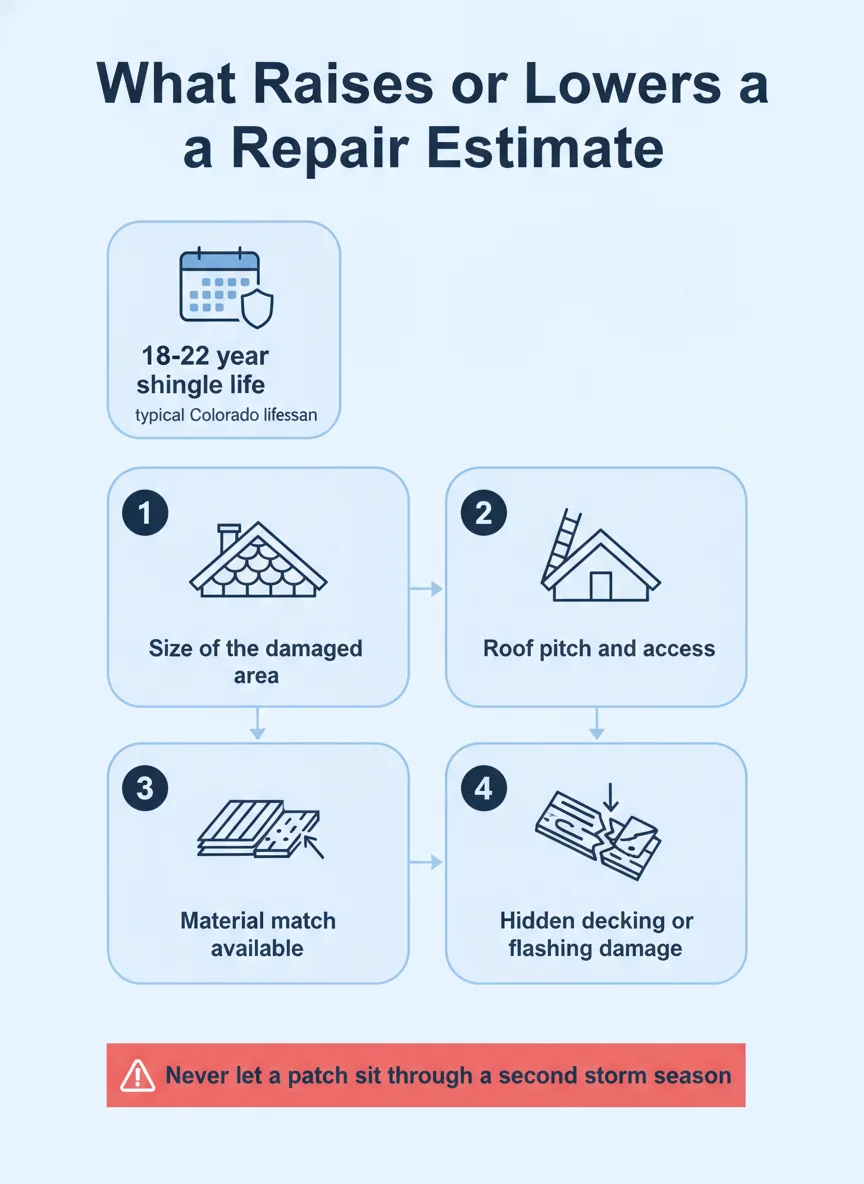
What Actually Drives the Price of a Roof Repair
A repair estimate isn't built off a single number per square foot. It's built from several factors layered together, and the two biggest are the condition of the roof itself and the nature of the damage.
The Roof Itself
An asphalt shingle roof in good overall shape with one localized problem area is usually the most straightforward and least expensive type of repair. Metal, tile, and flat roof systems each require different tools, fasteners, and sealing methods, so a repair on one of those systems typically takes more time and a different skill set than a shingle patch.
Age matters too. A roof nearing the end of its typical 18-22 year lifespan may have brittle or degraded material around the repair area, which can turn what looked like a quick fix into a larger job once the crew is on the roof. This is one reason a roof inspection before the repair is worth the time, even on something that looks small from the driveway.
The Damage and Access
A single missing shingle on a low, easily walkable roof is about as simple as a repair gets. Damage near a chimney, skylight, or valley is more involved, because those areas rely on flashing and sealing work that takes more care to get watertight again.
Steep pitch, multiple stories, or limited ground access around the house all add time to a job, since the crew has to set up safely before any repair work even starts. None of that shows up in a photo of the damage, which is part of why an in-person look always beats a phone estimate.
| Repair Type | Typical Scope | What Adds Time |
|---|---|---|
| Minor repair | A few shingles, a small flashing seal, or a localized leak fix | Hard-to-reach spots near steep pitch or multiple stories |
| Moderate repair | A damaged section including some decking or underlayment | Matching older or discontinued material |
| Major repair | Multiple damaged areas or a section near a valley, chimney, or skylight | Hidden rot found once the surface material is removed |
The Parts of a Roof That Actually Get Repaired
Most repairs involve one or more of three layers: the surface material (shingles, metal panels, or tile), the flashing around penetrations like chimneys and vents, and the decking underneath that everything is fastened to. A repair that stops at the surface layer is usually faster and more affordable than one that has to go deeper.
Flashing failure is one of the most common reasons a roof leaks even when the surface material still looks fine. Because flashing sits at every joint and penetration, it takes more precise work to reseal correctly, which is one reason flashing repairs often cost more than they appear to from the ground.
Step-by-step: How a Roofer Builds a Repair Estimate
A thorough repair estimate follows a fairly consistent process, whether the damage is from age, weather, or a one-time event. Here's roughly what that process looks like from the first call to the final number.
- Initial call: You describe what you're seeing, whether that's a stain on the ceiling, a missing shingle, or storm damage, so the crew knows roughly what to expect.
- On-site inspection: A technician walks the roof, documents the damage area, and checks for related issues nearby that aren't visible from the ground.
- Material check: The crew identifies what material the roof uses and whether a close match is available, which matters most on older or less common roof types.
- Scope confirmation: The estimate spells out exactly what's included, surface repair only or surface plus decking and flashing, so there's no confusion later.
- Scheduling: Repairs get scheduled around weather and material availability, with urgent leaks typically prioritized ahead of cosmetic issues.
- The repair itself: The crew removes the damaged material, checks the layer underneath, and rebuilds the area to match the surrounding roof as closely as possible.
- Final walkthrough: You get a look at the finished repair and a clear explanation of what was found and fixed before the crew leaves the site.
What You'll Typically Find Once the Repair Starts
Surface-Level Fixes
A surface-level repair is the best-case outcome. It usually means the damage stopped at the shingle, panel, or tile layer and the decking underneath is still sound. These repairs are quicker to complete and more predictable to price, since the crew isn't working around unknowns.
Surface repairs are common after a windstorm lifts a section of shingles or a single area wears out faster than the rest of the roof. As long as the repair happens before water gets a chance to sit underneath, this is usually where the job stays.
Deeper Problems Hiding Underneath
Sometimes a crew pulls back the surface material and finds soft or discolored decking, which means water has already made its way through. This changes the scope of the job, since damaged decking has to be cut out and replaced before any new surface material goes down.
This is also where flashing problems often get discovered, since a leak that seemed to come from one spot on the ceiling can actually trace back to a flashing seal several feet away. A good repair always traces the water to its actual source rather than just patching where the stain shows up inside.
DIY vs Calling a Licensed Roofer
There are a few maintenance tasks a homeowner can reasonably handle, like clearing debris off a low-slope roof or checking that nearby gutters are draining properly instead of backing water up under the edge of the roofline. These tasks don't involve cutting into roofing material and carry limited risk when done carefully and from a safe vantage point.
Actual repair work is a different story. Replacing shingles, resealing flashing, or working near a chimney or valley requires both the right materials and the experience to spot problems that aren't obvious from the surface. A repair done incorrectly can trap moisture rather than keep it out, which often costs more to undo than the original leak would have cost to fix.
Height and pitch are the other big factor. Most residential roofs are steep enough that working on them safely requires proper fall protection and experience, and a fall is a far more expensive outcome than any repair bill. When in doubt, a licensed roofer's time is worth paying for, both for the quality of the fix and for the simple fact that it keeps you on the ground.
Getting a Fair Repair Estimate in Colorado
The best way to get an accurate number is to have someone actually get on the roof and look, rather than estimating off a description or a photo from the ground. A clear estimate should spell out exactly what's being repaired, what material is being used, and whether the scope could change if hidden damage turns up once work starts. If you're weighing a repair against a full roof replacement, it helps to read through Roof Replacement: Repair or Replace, and How to Tell before committing either way.
Across the Denver Metro, from Denver to the surrounding suburbs, repair needs and roof types vary enough that a one-size estimate rarely holds up. Precise Roofing inspects before quoting, so the number you get reflects the roof you actually have rather than a guess.
Frequently asked questions
What makes one roof repair cost more than another?
The size of the damaged area, how steep or hard to access the roof is, and whether the underlying decking or flashing is also compromised all push a repair price up or down. A small, easily reached leak costs far less to fix than a damaged area near a chimney or valley on a steep pitch.
Is it cheaper to repair a roof than replace it?
In most cases, yes, a repair costs less upfront than a full tear-off, but that's only true when the roof's overall condition supports a repair. If the roof is near the end of its expected life or has damage spread across multiple sections, repeated repairs can end up costing more than one well-timed replacement.
Why did my roof repair estimate vary so much between contractors?
Different contractors often price for different scopes, with one quoting a surface patch and another quoting a full fix that includes replacing damaged decking underneath. Always ask exactly what's included so you're comparing the same job, not just the same number.
Does the type of roofing material affect repair cost?
Yes, some materials are faster to match and install than others, and steep-slope tile or standing seam metal generally take more time and specialized handling than asphalt shingles. Matching an existing material, especially an older or discontinued style, can also add time to a repair.
Will insurance cover the cost of my roof repair?
That depends on your policy and the cause of the damage, so it's worth having the repair documented and reviewed against your coverage before work begins. A contractor who works with insurance companies can help you understand what's likely to be covered and what falls outside the policy.