
How Much Roofing Material Does a Typical Colorado Home Need?
There isn't one answer, because the amount of material a roof needs depends on its actual surface area, not the square footage of the home underneath it. A 2,000 square foot ranch with a simple gable roof needs less material than a 2,000 square foot home with a steep pitch and several dormers, even though the floor plans look similar on paper.
Across the Denver Metro, homes range from simple single-story gables to complex multi-level roofs with valleys, hips, and dormers added over the years. That variation is exactly why a roofer measures the roof itself before giving you a material count, rather than working backward from the home's listed square footage.
How Roofers Calculate the Amount of Material You Need
Getting an accurate material count comes down to two things: measuring the actual roof surface and accounting for the waste that comes with cutting material to fit real angles, valleys, and edges. Both steps matter, and skipping either one leads to an order that's short on the day of install or padded with material you never needed.
Measuring in Squares
Roofing material is measured and sold in squares, with one square covering 100 square feet of roof surface. Once the roof's total area is known, dividing by 100 gives the number of squares needed before any waste is added, and that figure becomes the baseline for the entire material order.
Pitch changes that baseline. A steeper roof has more actual surface area than its footprint suggests, because the slope adds length to every plane. A roofer accounts for this with a pitch multiplier, which is why two homes with identical footprints can land on very different square counts once the roof is actually measured.
Waste Factor and Roof Complexity
A waste factor is extra material added on top of the measured squares to cover cuts, overlaps, and sections that can't be used efficiently. A simple roof with long, uninterrupted planes needs a small waste allowance, while a roof with multiple valleys, hips, and penetrations needs considerably more because so much material gets trimmed to fit those angles.
This is also where Roof Inspections earn their keep. Walking the roof in person surfaces complexity that photos from the ground or a satellite measurement tool simply miss, like a valley that runs longer than expected or a dormer that adds extra cutting on every course.
| Roof Type | Typical Waste Factor | Why |
|---|---|---|
| Simple gable, few penetrations | Low | Long uninterrupted planes mean fewer cuts |
| Hip roof with multiple planes | Moderate | More edges and hips require trimmed pieces |
| Roof with valleys and dormers | Higher | Valleys and dormer walls create extra cutting and waste |
| Steep or cut-up roof | Highest | Steep pitch and tight angles reduce usable material per bundle |
The Parts That Make Up a Full Roofing System
Field material is only part of the order. A complete roofing system also includes underlayment across the whole deck, flashing at every penetration and edge, starter material along the eaves, and ridge or hip caps along the top of every slope. Each of these is measured separately and added to the order alongside the field material.
Ventilation components, like ridge vents or other exhaust points, also factor into the total material list and the layout of the roof. Skipping any of these pieces to save on material almost always shows up later as a leak point or a shortened lifespan for the system as a whole, which is why a complete quote accounts for all of it upfront.
Step-by-step: How We Calculate Your Roofing Order
A material count isn't a single measurement, it's a sequence of steps that starts on the roof and ends with a finished order ready for delivery. Here's the general process behind getting that number right.
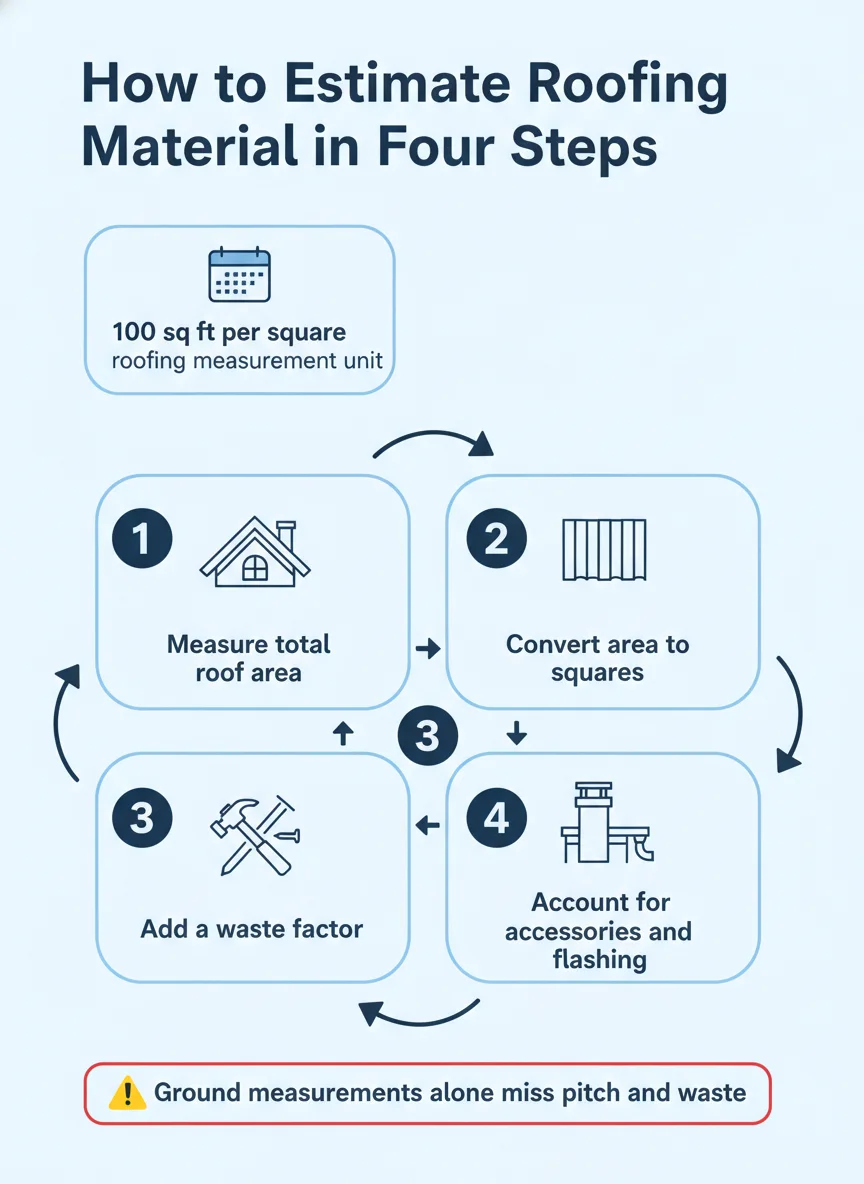
- Measure the roof: We walk the roof and measure each plane directly, rather than estimating from the ground or from a satellite image alone.
- Calculate total squares: Measured area is converted into squares, the standard 100 square foot unit used for ordering roofing material.
- Apply a pitch multiplier: Steeper roofs get an adjustment for the extra surface area created by the slope compared to the flat footprint.
- Add a waste factor: Valleys, hips, dormers, and penetrations each add cutting waste, so a complexity-based percentage gets added to the base count.
- Account for accessories: Underlayment, flashing, starter strip, and ridge or hip caps are measured separately and added to the material list.
- Confirm the final order: The completed count is reviewed against the roof's layout one more time before material is ordered for the job.
Why Did My Roofing Estimate Come in Higher Than I Expected?
An estimate that comes in higher than a rough online calculator usually means the roof is more complex than its footprint suggests. Multiple valleys, a steep pitch, or several roof penetrations all add real material and labor that a simple square footage estimate can't account for.
When the Estimate Comes in Higher Than Expected
A higher than expected material count is almost always a sign of complexity rather than a padded order. Roofs with chimneys, skylights, multiple dormers, or a steep pitch all require more flashing, more cutting, and a larger waste allowance, and all of that shows up as additional squares and accessories on the final list.
It's worth asking any roofer to walk through the measurement with you if a number feels off. A legitimate quote can point to the specific features driving the count, whether that's valley length, a steep upper story, or an unusually shaped footprint.
When Leftover Material Is a Good Sign
A small amount of leftover material at the end of a job is normal and expected, since waste factors are built in on purpose to cover unforeseen cuts and damaged pieces. A modest leftover pile usually means the crew planned the order carefully rather than running short mid-install.
A large surplus, on the other hand, can be a sign the waste factor was set too high for the roof's actual complexity. Either way, a clear material breakdown at the start of the job makes it easy to see where the numbers came from and whether they match what was actually installed.
DIY Measuring vs Calling a Pro for an Accurate Count
A homeowner can get a rough sense of material needs by measuring the home's footprint and applying a general pitch multiplier found online. That kind of estimate is useful for a ballpark budget conversation, but it isn't precise enough to order material against, especially on a roof with any real complexity.
Measuring the actual roof planes, walking valleys and hips, and accounting for every penetration is work that requires being on the roof safely, with the right tools and experience to know what counts as waste and what doesn't. That part of the process is best left to a licensed roofer rather than attempted from a ladder or an aerial photo.
Where a homeowner's judgment is genuinely useful is in catching early warning signs that a measurement is needed at all. Curling shingles, bald spots, or missing shingles after a windstorm are all reasons to call for an inspection before a full material count ever becomes necessary.
Getting an Accurate Material Count Starts With an Inspection
The only reliable way to know how much roofing material a home actually needs is to have someone measure the roof in person, plane by plane, with the pitch and complexity factored in from the start. Anything short of that is a rough guess, useful for early budgeting but not for placing an order.
Homeowners across Littleton and the rest of the Denver Metro can get that measurement done with a free inspection rather than guessing from the ground. Precise Roofing walks the roof, measures what's actually there, and builds a material list based on the real shape of your home instead of a general assumption.
Frequently asked questions
How many squares of roofing does an average house need?
It depends entirely on the footprint and roof shape, which is why a roofer measures the actual roof rather than guessing from square footage of the home. A simple gable roof on a modest home needs far less material than a roof with multiple valleys and dormers covering the same ground area.
What is a roofing square?
A square is the standard unit roofers use to measure and order material, equal to 100 square feet of roof surface. Estimates, invoices, and material orders are almost always expressed in squares rather than square feet.
Why do roofers order extra material beyond the measured area?
Roofers add a waste factor to cover cuts, overlaps, and complex areas like valleys and hips where material gets trimmed and some portion is unusable. A simple roof might need a small waste allowance, while a cut-up roof with lots of angles needs considerably more.
Does roof pitch affect how much material I need?
Yes, a steeper pitch increases the actual surface area of the roof compared to the home's footprint, so two houses with the same floor plan can need different amounts of material if their roof slopes differ. Steeper roofs also tend to need more careful handling, which can affect the waste factor.
Can I estimate my own roofing material needs?
You can get a rough idea by measuring the footprint and applying a pitch multiplier, but an accurate count requires someone on the roof measuring the actual planes, valleys, and penetrations. A free inspection is the most reliable way to get a number you can trust before ordering anything.