
Shingle pricing in the Denver Metro isn't one number
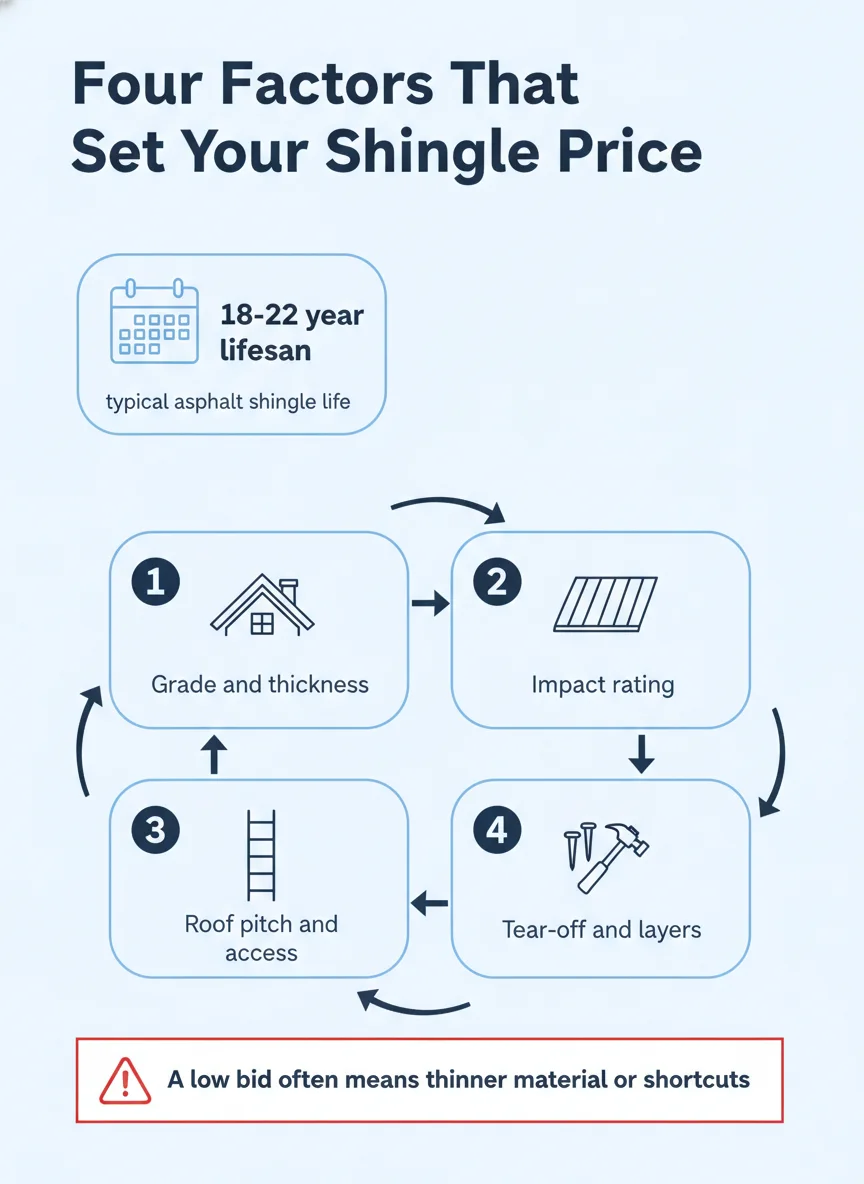
Ask five homeowners in Englewood what their new shingles cost and you'll get five different answers, and not because someone got ripped off. Shingle pricing depends on grade, thickness, impact rating, and how much work the roof itself demands before a single bundle goes down. The shingle is only part of the bill.
Colorado adds its own wrinkle. Hail is common enough along the Front Range that insurance carriers pay close attention to what's on the roof, and some offer pricing incentives for impact-rated products. That means the right shingle choice here isn't just about looks, it can affect your premium and your claim history for years.
Why grade and climate rating move the number
Shingles are built in tiers, and the tier you choose changes both the material cost and how the roof performs over its life. A basic three-tab shingle costs less upfront but has a shorter service life and less resistance to wind uplift. An architectural, or dimensional, shingle costs more per square but is thicker, heavier, and typically carries a longer manufacturer warranty.
Standard versus architectural shingles
Three-tab shingles are flat, uniform, and lightweight, which is exactly why they're the entry-level option. They work fine on a budget reroof, but in a high-UV, high-wind state like Colorado they tend to show granule loss and curling sooner than a heavier product.
Architectural shingles are laminated, so they have more mass and a dimensional look that also holds up better against wind. Most roofs going up along the Front Range today are architectural grade, which is one reason the per-square price has crept up over the years industry-wide.
Impact-resistant, or Class 4, shingles
Impact-resistant shingles use a reinforced mat designed to resist cracking from hail strikes, and they're tested and rated for that specifically. For a full breakdown of what the rating means and doesn't mean, see Class 4 Impact-Resistant Shingles in Colorado.
They cost more than a standard architectural shingle, but in a hail-prone market some insurers offer a discount for installing them, and they can mean fewer claims over the life of the roof. Whether that math works for your specific policy is a conversation worth having with your agent before you choose a product.
| Shingle type | Relative cost | Best fit |
|---|---|---|
| Three-tab | Lowest | Budget reroof, shorter hold on the home |
| Architectural | Mid-range | Most homes, longer lifespan, better wind rating |
| Class 4 impact-resistant | Highest | Hail-prone areas, possible insurance incentive |
The parts of the roof you don't see also set the price
Shingles sit on top of underlayment, flashing, and decking, and all of that gets touched during a roof replacement. A quote that only lists the shingle brand and skips the rest is leaving out most of the job. Underlayment quality, ice-and-water barrier at eaves and valleys, and flashing around chimneys and vents all add labor and material cost, and all of it affects how long the shingles actually last.
Roof pitch and access matter too. A steep roof or a home with limited ladder access takes longer to work safely, which shows up as labor hours rather than shingle cost, but it still raises the total bill. Multiple layers of old roofing also add to the job, since most roofers recommend stripping old material down to the deck rather than installing over it.
Step-by-step: how a shingle quote gets built
A straightforward process helps you compare quotes apples to apples instead of guessing why one number is higher than another.
- Measure the roof: The roofer calculates total square footage, pitch, and the number of valleys, hips, and penetrations, since all of it affects labor time.
- Pick the shingle tier: You choose between three-tab, architectural, or impact-resistant based on budget, how long you'll own the home, and local hail exposure.
- Price the tear-off: Removing existing layers and disposing of the old material gets priced separately from the new installation.
- Account for decking repair: Any rotted or soft decking found during tear-off gets replaced, usually priced per sheet as it's discovered.
- Add flashing and underlayment: New flashing at chimneys, vents, and valleys, plus underlayment and ice-and-water barrier, get built into the total.
- Confirm warranty terms: Manufacturer warranty length and any workmanship warranty from the installer should be spelled out in writing before you sign.
What a low bid is usually hiding
Thinner material or skipped layers
The fastest way to undercut a competitor's bid is to spec a lighter shingle or skip ice-and-water barrier in valleys. It looks identical from the curb on install day, but it shows up years later as premature granule loss or a leak at the valley during spring runoff.
Ask any bidder exactly which shingle line and underlayment they're quoting, not just a square-footage price. A roofer who won't name the specific products they plan to use is a yellow flag worth asking more questions about.
No allowance for decking repair
Decking damage isn't visible until the old shingles come off, so a responsible quote either includes an inspection allowance or clearly states how additional sheets get priced if they're needed. A bid with zero mention of decking is either assuming a perfect deck or planning to surprise you with a change order.
That's one reason a written roof inspection before a full tear-off is worth doing, even an informal walk of the attic from the inside. It gives you a sense of what's underneath before the crew ever shows up.
What you can decide yourself, and what needs a licensed roofer
Choosing a shingle color, tier, and warranty length is entirely your call, and it's worth spending real time on since it affects resale appeal and how the roof reads from the street. Comparing manufacturer warranty terms across product lines is something you can research on your own before a crew ever shows up.
What you can't do yourself is judge deck condition, proper flashing technique, or correct nailing pattern, since those require someone trained to spot problems that aren't visible from the ground. A licensed roofer also knows local code requirements for things like ice-and-water barrier placement, which a homeowner has no practical way to verify after the fact.
The split is simple: pick the look and budget tier yourself, then let a licensed crew handle everything from the deck down. That's where the workmanship warranty and the roofer's reputation actually matter more than the shingle brand.
Getting an apples-to-apples quote
The best way to compare shingle pricing across roofers is to ask each one for the same breakdown: shingle line and tier, underlayment type, tear-off scope, and warranty terms in writing. A quote that only lists a total dollar figure without those details is hard to judge against anything else you've received.
If a recent storm is part of why you're shopping for shingles in the first place, a storm and hail damage inspection can help separate what insurance should cover from what's simply wear and age, and Precise Roofing walks Denver Metro homeowners through that conversation as part of every estimate.
Frequently asked questions
Why do shingle quotes vary so much between roofers?
Quotes vary because shingle grade, underlayment, flashing work, and labor all differ between bids, not just the shingle brand itself. Two roofers pricing the same house can land far apart if one includes a full tear-off and the other doesn't.
Are thicker shingles always worth the extra cost?
Usually, yes, because thicker architectural shingles hold up better to Colorado's UV exposure and temperature swings than basic three-tab shingles. The tradeoff is weighing the upfront cost against how long you plan to stay in the home.
Do impact-resistant shingles cost more?
Impact-resistant shingles typically carry a higher material cost than standard shingles because of the reinforced mat used to meet the rating. Some insurance carriers offer a premium discount for installing them, so it's worth asking your agent.
Does roof pitch really change the price?
Yes, a steep or multi-story roof takes longer to work safely and often requires extra harness and staging equipment, which adds labor time. A simple single-story roof with a low pitch is generally the fastest and least expensive to work on.
Is it cheaper to install new shingles over the old layer?
A roof-over can lower upfront labor cost, but most roofers recommend a full tear-off so the deck and flashing can be inspected and the new shingles lay flat. Hidden deck damage under an old layer can cost more to fix later than it would have to address now.