
Why Coverage Questions Come Up So Often in Colorado
Across the Denver Metro and the rest of Colorado's Front Range, roofs take a beating from weather that swings between intense summer hailstorms and heavy winter snow loads. That combination means more homeowners here end up filing a roof-related insurance claim at some point than in milder climates, and more of them are confused about what their policy actually covers.
The short answer is that insurance covers sudden, accidental damage, not the slow decline every roof goes through over the decades. Understanding that line before you call your insurer saves time, sets realistic expectations, and helps you spot the difference between a legitimate claim and a repair you'll be paying for out of pocket.
How Insurance Companies Decide What Qualifies
Every standard homeowners policy is built around the idea of a 'covered peril,' a specific, identifiable event that caused the damage. Wind, hail, falling tree limbs, and fire are classic examples. What an adjuster is really doing during an inspection is trying to answer one question: did something sudden happen, or did this roof just wear out?
Sudden and Accidental Damage
This is the category most claims fall into. A hailstorm that bruises shingles, a windstorm that lifts and tears off a section of roofing, or a branch that punches through decking are all events with a clear before-and-after. The damage didn't exist last month and it exists now, tied to a specific date you can point to on a weather record.
Because these events are documentable, they're also the easiest to support with evidence. Photos taken close to the storm date, paired with a professional roof inspection, give an adjuster exactly what they need to approve a claim without a drawn-out back-and-forth.
Gradual Wear and Deferred Maintenance
Every roofing material has an expected lifespan, and insurers price policies with that lifespan in mind. Curling shingles, worn-out flashing, or a roof that's simply reached the end of its serviceable years is treated as a maintenance issue, not an insurable loss, even if the end result is the same leak in your ceiling.
This is also where unrepaired damage from an earlier storm can hurt a later claim. If a roof had hail damage two years ago that was never addressed, and a new leak shows up in the same area, an insurer may argue the real cause is the neglected prior damage rather than anything new.
| Damage Type | Typically Covered | Typically Not Covered |
|---|---|---|
| Hail bruising on shingles | Yes, with documented storm date | N/A |
| Wind-torn shingles or flashing | Yes, tied to a specific storm | N/A |
| Curling, cracking shingles from age | N/A | Yes, treated as wear and tear |
| Leak from years of deferred maintenance | N/A | Yes, treated as neglect |
The Parts of the Roof an Adjuster Actually Inspects
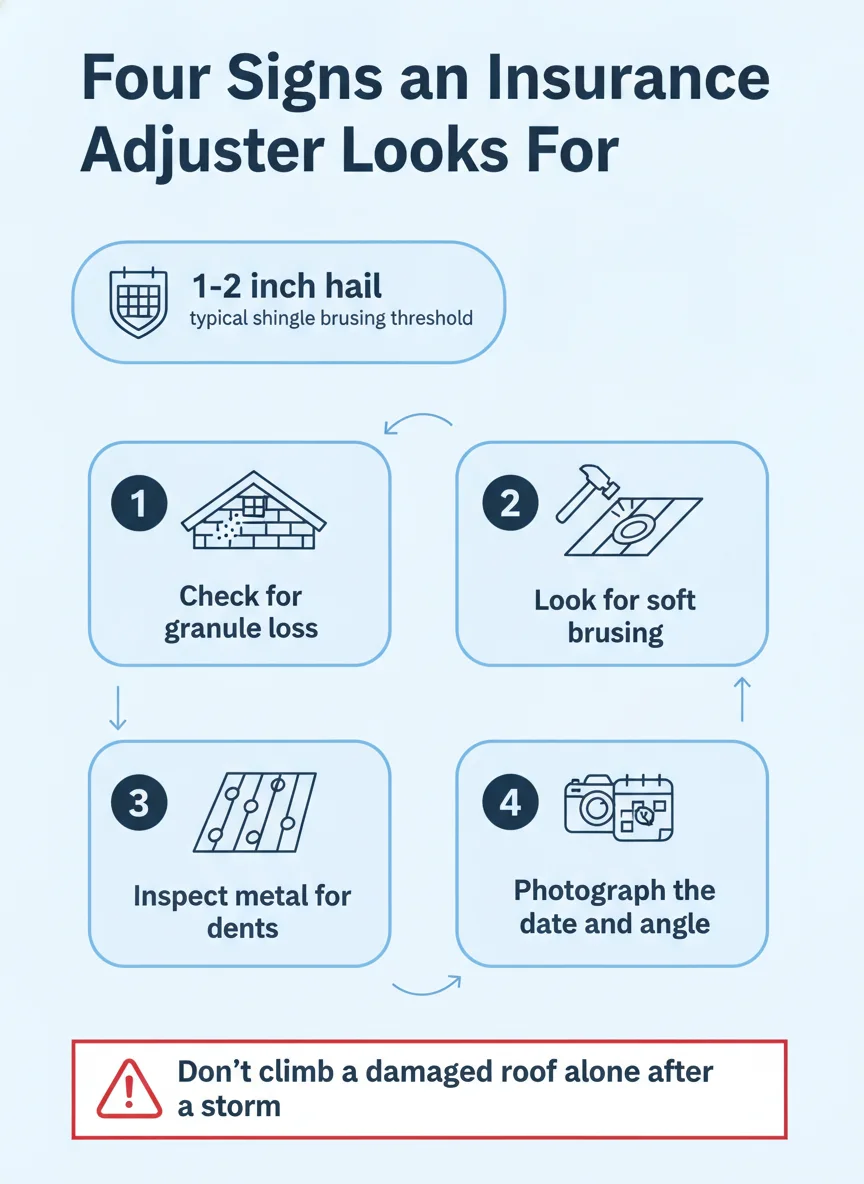
An adjuster doesn't just glance at the shingles from the driveway. A thorough inspection covers the whole roofing system, because damage in one area often signals a problem somewhere else. Flashing around chimneys and vents, the valleys where two roof slopes meet, and the gutters and downspouts all get checked, since wind and hail damage those components just as often as the field of the roof.
Soft spots in decking, granule buildup in gutters, and dented metal vents or caps are all details that support a claim even when the shingles themselves look mostly intact from the ground. This is part of why a walk-through with a trained eye catches far more than a homeowner scanning from a ladder.
Step-by-step: Documenting Roof Damage for a Claim
If you suspect storm damage, the way you document it in the first few days shapes how smoothly the claim moves. Here's the general order most successful claims follow.
- Note the storm date: Write down the date and type of weather event, since insurers tie claims to a specific occurrence rather than a vague timeframe.
- Photograph visible damage: Take wide and close-up photos from the ground of anything unusual: missing shingles, dented vents, debris in gutters.
- Schedule a professional inspection: A trained inspector can safely access areas you shouldn't climb to and will document damage in terms an insurer recognizes.
- Request a written report: Ask for a detailed report with photos, since this becomes the backbone of your claim file.
- File the claim promptly: Contact your insurer as soon as damage is confirmed, since most policies have a reporting window.
- Meet the adjuster on site: Having your inspection report and photos ready when the adjuster arrives helps align their assessment with what's actually there.
What You'll Typically Find After the Inspection
Results generally fall into one of two buckets: damage severe or widespread enough to justify a full roof replacement, or isolated damage that a targeted roof repair can resolve. Which one applies depends on how much of the roof was affected and how the material responded to the impact.
When the Damage Supports a Full Claim
Widespread hail bruising across most slopes, large sections of torn-off shingles, or structural damage to decking usually points toward replacement. Insurers generally approve full replacement when the damage is spread across enough of the roof that patching individual spots wouldn't restore it to its pre-storm condition.
In these cases, matching materials across an entire slope or the whole roof becomes part of the settlement discussion, since code and manufacturer guidelines in some cases limit mixing old and new shingle runs on the same plane.
When the Damage Is Isolated
A handful of cracked shingles near one edge, a single dented vent cap, or flashing that pulled loose in one spot are often resolved with a repair rather than a full claim. These smaller findings still matter though, since left alone they're exactly the kind of unaddressed damage that can complicate a future claim.
If you're unsure which category your situation falls into, our storm and hail damage service includes documentation built for this exact decision point.
What You Can Check Yourself vs. What Needs a Licensed Roofer
There's a limit to what a homeowner should be doing on a roof, especially after a storm when surfaces are wet or materials are already compromised. Checking your gutters from the ground, scanning your ceiling for new stains, and photographing anything you can see from a safe vantage point are all reasonable first steps.
Walking the roof itself, probing flashing, and assessing hidden decking damage are jobs for a licensed roofer. Not only is it safer, but insurers give more weight to a professional assessment than to a homeowner's photos alone, since the documentation needs to speak the adjuster's language.
If you're comparing quotes or reports from different contractors, remember that a dramatically lower estimate can be a sign of corners being cut rather than a bargain, and checking credentials matters as much as checking the price.
Getting a Claim Right the First Time
Knowing the general line between a covered loss and ordinary wear puts you in a stronger position before you ever pick up the phone to call your insurer. It also helps you avoid the common mistake of assuming every roof problem is a claim, or the opposite mistake of writing off real storm damage as something you'll just live with.
Precise Roofing has worked alongside homeowners and insurance companies across the Denver Metro for more than 20 years, documenting damage clearly enough that claims move without unnecessary delay.
Frequently asked questions
Does homeowners insurance cover a roof leak?
It depends on what caused the leak. A leak from a sudden event like wind-driven rain or hail damage is typically covered, while a leak caused by age, neglect, or a roof that was already failing usually is not.
Will my insurance company cover a full roof replacement or just a repair?
Insurance generally pays to restore the roof to the condition it was in before the covered event, which can mean a full replacement if the damage is widespread or a targeted repair if it's isolated. The adjuster's assessment of the extent of damage drives that decision.
What roof damage is not covered by insurance?
Most policies exclude damage from gradual wear, poor maintenance, prior unrepaired damage, and normal aging, since those are considered the homeowner's responsibility rather than a sudden loss. A roof that's simply old and worn out at the end of its expected life typically doesn't qualify.
How soon after a storm should I file a roof damage claim?
File as soon as you notice damage or suspect it, since most policies set a window for reporting a loss and delays can weaken a claim. Getting an inspection documented quickly also helps establish that the damage is tied to a specific storm date.
Do I need a professional inspection before filing a claim?
A professional inspection is the clearest way to document damage in terms an adjuster and insurance company will recognize. It also gives you an independent record of the roof's condition, which matters if the insurer's assessment comes back lower than expected.