
Why Valleys Are the Hardest-Working Part of a Colorado Roof
Any spot where two roof planes meet at an angle is called a valley, and it exists because most homes aren't one simple rectangle. Dormers, additions, and multi-gable designs all create these seams, and every one of them becomes a water highway during rain or snowmelt. Instead of runoff spreading evenly across a single slope, two slopes worth of water converges into one narrow channel and picks up speed on the way down.
In the Denver Metro and across Colorado's Front Range, that channel also deals with freeze-thaw cycles, sudden spring snowmelt, and the kind of wind-driven rain that pushes water sideways instead of straight down. A valley built to a lower standard, or one that's simply aged past its prime, tends to show problems here first. That's why most roof inspections start by checking the valleys before looking anywhere else.
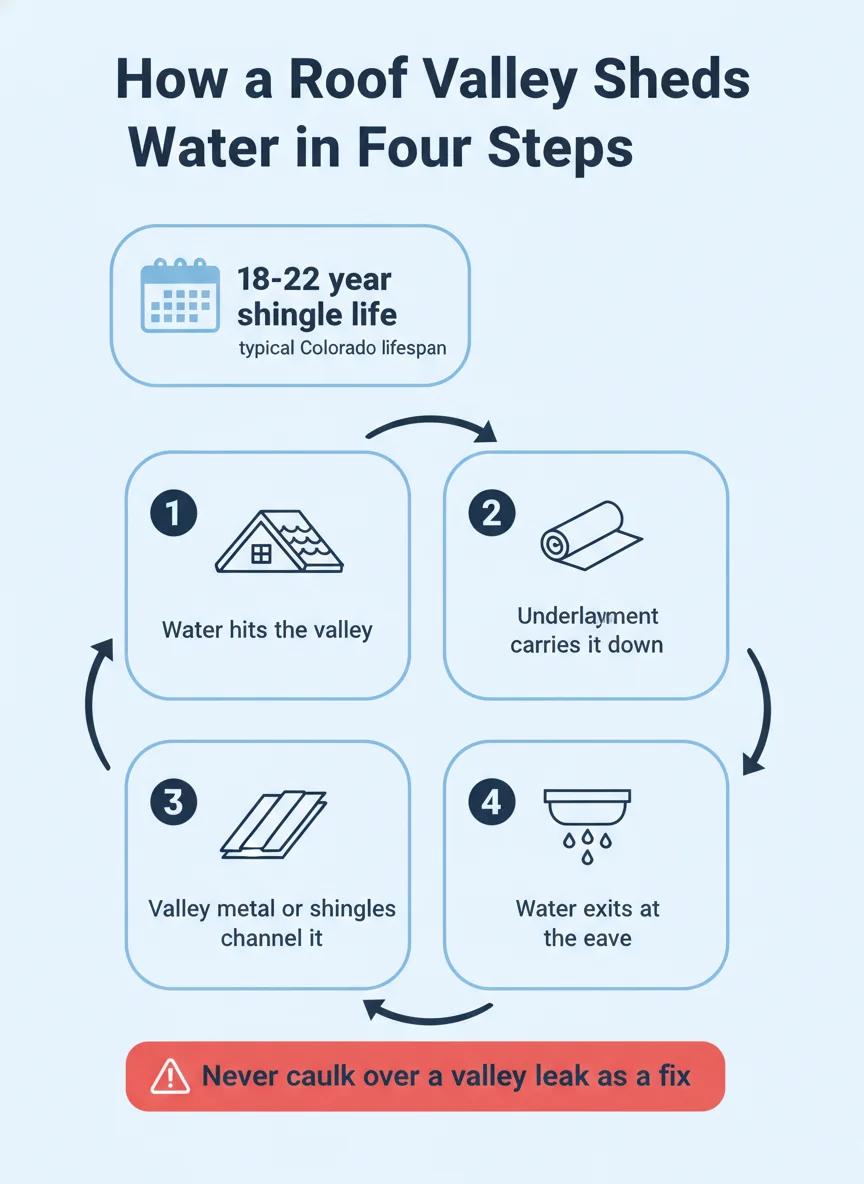
How a Valley Actually Sheds Water
Underneath the visible surface, a valley depends on layers working together rather than one single material. A self-adhered ice and water membrane typically runs the full length of the valley first, sealing tight around the nails and seams that come later. On top of that sits either a strip of metal flashing or the shingles themselves, depending on which valley style the roof uses.
Closed-Cut Valleys
A closed-cut valley runs shingles from one slope across the seam and then trims the shingles from the opposing slope right along that line, leaving a single continuous shingle surface. It's the more common style on residential asphalt shingle roofs because it blends into the rest of the roofline with almost no visible metal.
The tradeoff is that the shingles in that cut line take the brunt of the water flow, so they tend to show granule loss and wear faster than shingles anywhere else on the roof. The underlayment beneath is doing a lot of the long-term work, which is part of why a quality membrane matters as much as the shingles on top of it.
Open Metal Valleys
An open valley leaves a strip of metal, usually a W-profile or a simple flat pan, exposed down the center with shingles trimmed back on both sides to reveal it. Water runs across the smooth metal instead of over shingle granules, which generally handles higher volumes of water with less friction.
Open valleys show up more often on steeper pitches, metal roof systems, and homes where heavier water or snow load is a known factor. They cost a bit more in materials and install time, but the metal itself typically lasts longer than the surrounding shingles since it isn't exposed to the same surface wear.
| Valley Type | How It's Built | Best Suited For |
|---|---|---|
| Closed-cut | Shingles run through and are trimmed along the seam | Standard asphalt shingle roofs with moderate water flow |
| Open metal | Metal pan exposed, shingles trimmed back on both sides | Steeper pitches, metal roofs, or heavy runoff areas |
| Woven | Shingles from both slopes interlace across the seam | Older roofs, less common on new installs today |
What's Underneath the Shingles in a Valley
Pull back the shingles on any valley and you'll find a stack of materials doing quiet, unglamorous work. The deck itself, usually plywood or OSB sheathing, has to be solid and free of rot before anything else goes on top, since a soft deck undermines everything installed over it.
Above the deck sits the ice and water membrane, often extending further up each slope in a valley than it does elsewhere on the roof because of how much water passes through. Then comes either the metal flashing or the first course of shingles, followed by the finish layer. Each piece has to overlap the one below it correctly, because a valley built shingle-first with the laps running the wrong direction will funnel water straight under itself instead of over it.
Step-by-step: How a Valley Gets Roofed
The exact sequence varies with valley style and roofing material, but the general order a roofer follows looks like this.
- Check the deck: The sheathing is inspected for rot or soft spots and replaced where needed before anything new goes down.
- Run the membrane: A self-adhered waterproof underlayment is laid the full length of the valley, centered over the seam.
- Set the flashing or first course: Metal flashing is fastened down, or the first shingle course is run through for a closed-cut valley.
- Trim the opposing slope: Shingles from the second slope are cut back along a chalk line to the correct offset from the centerline.
- Seal the cut edges: Exposed shingle edges along the valley are sealed to keep wind-driven rain from working underneath.
- Check the flow: The finished valley is checked to confirm water runs smoothly from the ridge down to the eave with no dams or ridges.
What a Failing Valley Looks Like
Signs Inside the Attic
A valley leak often shows up in the attic before it ever reaches a ceiling, so a flashlight check after a heavy rain can catch a problem early. Look for dark streaking on the underside of the decking directly beneath where the valley runs, or for insulation that feels damp or matted along that same line.
A musty smell that's strongest near the center of the attic, rather than near an outside wall, is another clue the water is coming from a valley rather than a simple wall flashing or vent. Catching it at this stage usually means a smaller repair instead of replacing damaged decking.
Signs on the Roof Surface
From the ground or a ladder, a failing closed-cut valley often shows bald, granule-stripped shingles right along the seam while the rest of the roof still looks fine. An open metal valley that's failing may show rust streaks, a lifted or dented pan, or debris buildup that's holding water against the metal instead of letting it drain.
Curling or cracked shingles near the valley edge, or a visible gap where the trimmed shingle meets the metal, both point to a detail that's worked loose over time. Any of these are worth a closer look rather than waiting for a leak to confirm it.
DIY vs Calling a Licensed Roofer
A homeowner can reasonably handle clearing debris out of a valley, checking the attic for staining after a storm, and doing a visual check from the ground with binoculars. Those are low-risk tasks that don't require getting on the roof or touching the flashing itself.
Anything involving pulling shingles, replacing valley metal, or re-running underlayment is a job for a licensed roofer, both for safety reasons and because a valley repair done wrong tends to fail faster than the original problem. Matching the overlap direction, the membrane width, and the fastening pattern correctly takes experience most homeowners don't get the chance to build.
A free inspection is usually the fastest way to find out whether a valley issue is a quick repair or a sign of wider wear across the roof. That's also the right time to ask about Roof Repair options versus a larger project if the rest of the roof is getting close to the end of its service life.
Getting a Valley Built Right the First Time
A roof is only as good as its weakest detail, and valleys are consistently where that weak detail shows up first across Front Range homes in Denver and the surrounding towns. Reading up on how long each roof type lasts in Colorado is a good next step if you're weighing whether a valley repair or a fuller replacement makes more sense for your roof's age.
Whether it's a quick check after a hard rain or a full valley rebuild, getting the layering right the first time saves a lot of trouble down the road. Precise Roofing has been handling these details on Denver Metro roofs for over 20 years and can tell you quickly which category your roof falls into.
Frequently asked questions
What is a roof valley and why does it leak so often?
A roof valley is the inward angle where two roof slopes meet, and it carries far more water than any other part of the roof because runoff from both sides funnels into it. That concentrated flow is exactly why valleys wear out or leak before the rest of the roof does.
What's the difference between an open and a closed valley?
An open valley leaves a strip of metal flashing exposed down the center so water runs over a hard, smooth surface. A closed valley weaves or cuts the shingles themselves over the seam, which looks cleaner but relies entirely on the underlayment beneath if a shingle ever fails.
Can a roof valley be repaired without replacing the whole roof?
Yes, in many cases a valley can be repaired on its own if the rest of the roof is sound, since it's a localized detail rather than a whole-roof system. If the valley metal has rusted through or the underlayment has failed in multiple spots, a wider repair or a section replacement may make more sense.
How long does valley flashing last compared to the rest of the roof?
Valley metal generally outlasts the shingles around it when it's installed correctly, since it's not exposed to the same granule wear and UV breakdown. Shingles in a closed valley, on the other hand, often show wear before the rest of the roof because they take on more water volume.
Is a leaking valley an emergency?
A leaking valley should be looked at quickly, because it's usually moving a lot of water fast and the damage underneath can spread before it ever shows up as a stain on the ceiling. If you see water coming in near a valley during or after a storm, it's worth getting a roofer out sooner rather than later.